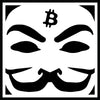


Bitcoin art is the propaganda arm of a peaceful monetary revolution. That's the honest definition, and it's the one you won't find on Wikipedia.
I've been making Bitcoin art since 2017, and full time since 2018. Before that I was in corporate finance with a Master's degree and a front-row seat to how the money machine actually works. I walked away from that to paint, glitch, and print the case for better money. So when people ask me "what is Bitcoin art?" I don't give them the sanitized answer. I give them this one.

What Is Bitcoin Art?
Bitcoin art is visual work created about, for, or on Bitcoin. Three prepositions, three layers of the same movement:
- About Bitcoin — art that takes Bitcoin, fiat currency, central banking, inflation, and monetary freedom as its subject. The message is the medium's reason to exist.
- For Bitcoin — art made to spread the idea. Posters, prints, memes, murals. Work designed to orange-pill someone who's never read a whitepaper and never will.
- On Bitcoin — art inscribed directly onto the Bitcoin blockchain as Ordinals, living on the most secure ledger humans have ever built. Not a link to a file. The file itself, on-chain, forever.
What separates Bitcoin art from "crypto art" in general is conviction. Crypto art chased whatever chain was pumping. Bitcoin art picked a side and stayed there. This isn't decoration and it isn't speculation. It's a body of work arguing, piece by piece, that the money we were born into is broken and that something better already exists.
Every piece has a message. That's the bar.
Why Artists Make Art About Money
Because money is the water we all swim in, and almost nobody looks at it.
Think about what a dollar bill actually is: a designed object. Engraved portraits, guilloché borders, seals, serial numbers, Latin mottos. Fiat currency is the most widely distributed artwork in human history, and it's propaganda for the state that prints it. Every banknote in your pocket is telling you a story about authority, trust, and who's in charge.
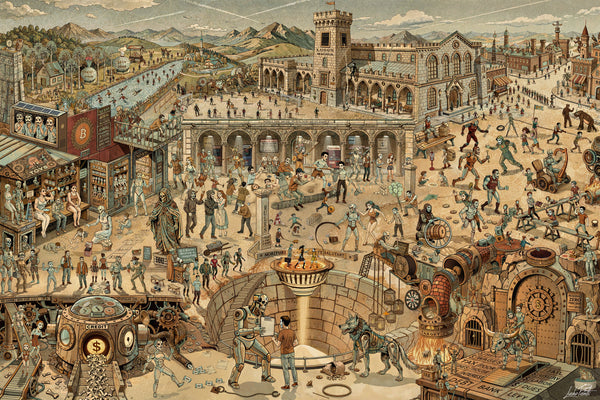
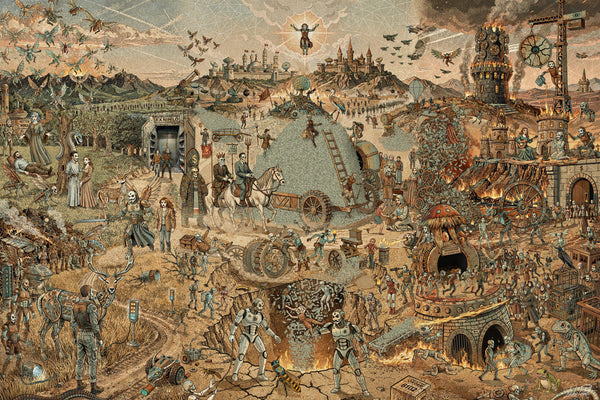
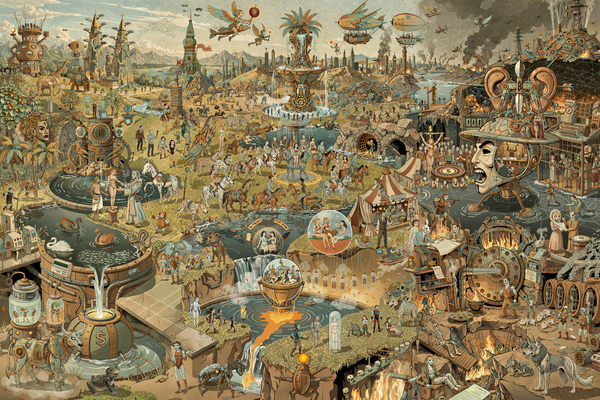
Bitcoin artists flip that. We take the visual language of money — the engraving, the borders, the official seals — and we use it to tell the other story. The one about the 2008 bailouts. About savings quietly bleeding value year after year while wages stand still. About a system where they print and we pay.
I lived the first story. I studied finance, I earned the Master's, I worked inside the machine. And what I saw was a bunch of problems dressed up in professional language. Inflation is a hidden tax. Debt is the product. The cracks were everywhere once I stopped pretending not to see them. Art became the way I could say that out loud — louder than any spreadsheet ever could.
There's also a deeper reason artists gravitate to Bitcoin specifically: it's the first money in history with no ruler on it. No king, no president, no central bank governor. Bitcoin arrived with no face, launched by a pseudonymous founder who vanished. That's a visual vacuum. And artists rushed in to fill it — with masks, with symbols, with iconography built by the people who use the money instead of the people who issue it. We're painting the portrait fiat never let us paint: money that belongs to everyone and answers to no one.
The Propaganda-Art Tradition
I call my work visual propaganda, and I mean it as a technical term, not an edgy one.
Every major movement in history was visualized before it was realized. WWII ran on posters. Revolutions ran on pamphlets and woodcuts. Soviet constructivists, French poster artists, protest printmakers — they all understood something that Edward Bernays and Gustave Le Bon wrote down plainly: crowds don't move on arguments, they move on images. A strong image bypasses the debate and lodges in the gut.
Bitcoin art stands squarely in that lineage. The difference is who it serves. Historical propaganda mostly served states and armies. This propaganda serves an idea that no one owns: sound money, individual sovereignty, an exit from the fiat system. It's propaganda pointed back at the propagandists.
That's why so much Bitcoin art borrows the aesthetics of banknotes, war posters, and protest signs. We're not being ironic. We're using the most battle-tested visual weapons ever made, for the first cause that doesn't need a bullet fired.
A Short History of the Movement: 2013 to the Ordinals Era
Nobody handed Bitcoin artists a market. We built one, in public, over more than a decade.
2013–2015: The meme trenches. The earliest Bitcoin art lived on forums and early platforms — crude, funny, ideological, and free. Artists like cryptograffiti were repurposing physical currency and street art to talk about Bitcoin while the rest of the world was still laughing at it. Projects on early protocols like Counterparty proved you could attach art and collectibles to Bitcoin itself years before anyone said "NFT."
2016–2018: Rare Pepes and the birth of scarce digital art. The Rare Pepe movement on Counterparty was chaotic, absurd, and historically important: it established that digital images could be provably scarce and traded. Meme culture and monetary theory fused. This era gets dismissed because it was funny. It shouldn't be. It was the proof of concept.

2019–2021: The crypto art boom. Platforms like SuperRare turned digital art into a real market with real collectors. I minted my first NFT on SuperRare in September 2019, back when explaining that sentence at a dinner party took twenty minutes. Then 2021 detonated. Prices went vertical, headlines followed, and a flood of speculation buried a lot of the signal. Bitcoin artists kept working through the noise — the ones with a message stayed; the ones with a business model left.

2023–present: The Ordinals era. In January 2023, the Ordinals protocol changed everything: for the first time, art could be inscribed fully on Bitcoin itself. Not a token pointing at a server. The actual image, in the actual blocks, secured by the most powerful computing network on Earth. For Bitcoin artists this was the homecoming. The art about Bitcoin could finally live on Bitcoin. My own on-chain work exists because of this shift — inscribed pieces like the Satoshi Icons, plus Satoshi Glitchers, a 2,420-piece recursive collection of animated layers now in production for inscription.

Thirteen years in, the movement has gone from forum memes to museum conversations. And the fiat system it critiques has spent those same thirteen years proving the artists right.
Physical, Digital, and On-Chain: The Three Bodies of Bitcoin Art
Bitcoin art isn't one format. It's three, and serious collectors usually end up touching all of them.
Physical. Prints, canvases, screen prints, hand-embellished editions. This is where Bitcoin art meets the traditions of printmaking and propaganda posters. Physical work is signed, numbered, and often produced in editions with meaning baked into the count — my Bitcoin Certificates run in editions of 21, echoing Bitcoin's 21 million cap. A signed print on your wall does something a JPEG can't: it converts your living room into a broadcast station for the message.

Digital. Editioned digital works and 1/1s on NFT platforms. This is where the crypto art market matured, where provenance became programmable, and where artists like me found our first global collectors. Digital-native work can move, glitch, and animate — the medium matches the subject.
On-chain. Ordinals inscriptions on Bitcoin. The purest form: the artwork itself stored in Bitcoin's blockchain, immutable, with no server, no platform, and no company that can rug it. If Bitcoin exists, the art exists. For a movement about removing trusted third parties from money, putting the art itself beyond any third party isn't a gimmick. It's the thesis, completed.
How Bitcoin Art Is Collected
You don't need permission, a gallery relationship, or a fortune to start. Here's the honest path.
1. Follow the artists, not the floor prices. Bitcoin art is a conviction market. Find artists whose message you'd defend at a dinner table. Read their writing, watch their process, look at whether the work holds together as a body or just chases trends. Crafted beats generated, and depth beats hype, every cycle.
2. Start physical if you're new. A signed, numbered, limited-edition print is the lowest-friction entry into the movement. You get a real object, authentication in hand, and art that starts conversations. My collector editions ship worldwide from luchopoletti.com.
3. Go digital when you're ready for provenance. Collecting editioned digital work or 1/1s puts you on the public record of the movement's history. Ownership is verifiable by anyone, forever.
4. Go on-chain when you understand why it matters. Collecting Ordinals means holding art the same way you hold bitcoin: your keys, your art. Start by learning how inscriptions work — I wrote a full collector's guide to Bitcoin Ordinals, and my on-chain collections live at luchopoletti.com/pages/ordinals.
5. Verify everything. Real Bitcoin artists make verification easy — hand-signed editions, blockchain-anchored certificates of authenticity, public provenance. If authentication is vague, walk away. This movement was built on "don't trust, verify," and the art market inside it should meet the same standard.

This Is Bigger Than a Market
Here's what I want you to take from this: Bitcoin art isn't a niche of the art world. It's the visual record of the first peaceful monetary revolution in history, made in real time, by people with skin in the game.
The most important art movements were never the comfortable ones. They were the ones that looked at power and told the truth about it. Fiat has had five centuries of court painters. Bitcoin has us.
If the message resonates, don't just scroll past it. Own a piece of it. Put it on your wall, hold it in your wallet, and let it do what propaganda does best — start conversations that change minds.
Explore the work at luchopoletti.com, or go straight to the on-chain collections at luchopoletti.com/pages/ordinals.
Better money, better world. Stay sovereign.
Leave a comment