

The Visual Language of a Revolution
Bitcoin isn't just a protocol. It's a symbol. And symbols change the world.

Bitcoin on the Brink.
When I started making art about Bitcoin, I didn't just learn code or economics. I learned to see the visual language everyone was absorbing: the orange circle, the ₿ with vertical lines, the Satoshi mask. These aren't accidents. They're the vocabulary of a monetary revolution, and understanding bitcoin symbolism in art is understanding how that revolution actually spreads.
Every movement that changed history figured this out before it won. The ideas recruit the first believers. The symbols recruit everyone else.
The Orange Circle: A Flag Disguised as a Logo
Orange emerged as Bitcoin's visual anchor: warm, energetic, contrarian. No committee picked it. No brand agency presented it on a slide. An anonymous forum member drew a white ₿ tilted inside an orange circle in Bitcoin's earliest years, released it freely, and the community simply adopted it. That's the only way a real flag is ever born: not assigned, but claimed.
And that's what the orange circle is. Not a logo. A flag.
Corporate logos are owned. They have trademark lawyers and usage guidelines. The orange circle belongs to no one, which means it belongs to everyone who's opted out of the fiat system. When someone puts it in their profile, wears it on a shirt, or stencils it on a wall in Buenos Aires or Beirut, they're not promoting a product. They're declaring allegiance to an idea: money that no government can print.
When I paint that orange circle, I'm encoding resistance. I'm painting a symbol that says: better money, better world.
The ₿: A Currency Symbol Nobody Asked Permission For
The dollar sign, the euro, the pound: every fiat currency symbol was institutionalized by a state. The ₿ glyph, a capital B with two vertical strokes echoing the dollar sign it intends to replace, was created and spread by the community itself. It even earned its own Unicode character. A people's currency got a people's symbol, and the machinery of the world had to make room for it.
The Bitcoin symbol functions like a seal. For centuries, seals were how power announced itself: kings pressed them into wax, central banks engraved them onto notes. In my work, the ₿ often appears breaking through corporate logos and government seals. That's the composition doing the arguing: decentralized money breaking centralized power.
Laser Eyes: The Meme as Initiation
In early 2021, Bitcoiners started photoshopping red laser eyes onto their profile pictures. It looked absurd. It was supposed to. Laser eyes were folk symbolism, born from the crowd the same way the orange circle was: a visual handshake that instantly told you who was in the fight.
Art historians will tell you that halos in medieval painting did the same job: a visual marker separating the committed from the crowd. Laser eyes are the meme-age halo. Crude, funny, self-aware, and doing exactly what sacred symbols have always done: marking conviction so it can be seen, and spread.
I take memes seriously as an artist, because memes are how symbols reproduce now. A symbol that can't survive as a meme can't survive at all.
The Satoshi Mask: The Face of No One
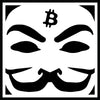
The Satoshi Mask is my own contribution to this vocabulary. I created it in 2018, reworking the Guy Fawkes mask into a face for Bitcoin's anonymous creator, and I've evolved it ever since: dozens of variations, male and femme, divine forms and glitched ones. It's become the icon of my whole body of work, and the face of my Satoshi Icon collection.
Why a mask? Because Satoshi Nakamoto's greatest design decision wasn't in the code. It was disappearing. Bitcoin has no CEO to arrest, no founder to corrupt, no face to put on trial. The mask represents privacy, principle over ego, and anonymity as power. Anyone can wear it. That's the point. Satoshi is no one, so Satoshi can be everyone.
When I paint it, I'm painting freedom.
The mask's sibling, the all-seeing Satoshi eye from my Satoshi Sees collection, flips the surveillance state's favorite symbol back on itself. They watch us through cameras and bank records. Satoshi sees them through an open ledger anyone can verify.
The Propaganda Lineage: This Has All Happened Before
None of this is new. It's the oldest playbook in visual culture, and I studied it deliberately.
Wartime propaganda posters mobilized entire nations with flat colors, bold type, and a single unmissable idea per image. Governments understood that a poster could do what a policy paper never could: make millions of people feel something at a glance, and act on it.
Shepard Fairey proved the same mechanics work from the street up. OBEY started as a sticker; the Hope poster helped elect a president. One artist, one repeated image, massive ideological reach.
I read the theorists behind these campaigns, Edward Bernays and Gustave Le Bon, the men who literally wrote the manuals on mass persuasion. Le Bon said the imagination of crowds is impressed above all by images. The fiat system has used that knowledge against us for a century: every banknote is a small propaganda poster for state power, engraved with seals, temples, and founding fathers.
My work takes the same weapons and points them the other way. I call it what it is: visual propaganda for the peaceful monetary revolution. The difference between my propaganda and theirs is simple. Theirs needs a monopoly on violence to back the message. Mine just needs to be true.
Why Symbols Beat Whitepapers
Here's the uncomfortable fact for the engineers: almost nobody reads the Bitcoin whitepaper. It's nine pages long and most of the world will never open it.
But everyone can read an orange circle.
Adoption doesn't move at the speed of understanding. It moves at the speed of recognition. A symbol compresses an entire argument, fixed supply, no rulers, exit from a rigged system, into something that transmits in a quarter of a second and crosses every language barrier on earth. The whitepaper convinces one careful reader at a time. The symbol recruits crowds.
That's the real bitcoin art meaning, if you want it in one sentence: Bitcoin art is the translation layer between a monetary revolution and the human beings it's for. The protocol secures the money. The art carries the message. Neither works alone.
The most powerful movements in history were visualized before they were realized. Bitcoin will be no different.
Why This Matters Now
We live in an era of monetary debasement. Every unit of fiat currency in your account is quietly bleeding value into someone else's bailout. Bitcoin offers an alternative, but alternatives don't spread on math alone. They need flags. They need faces. They need art.
That's the work. Since 2017 I've been building this visual language piece by piece, the way propaganda artists before me built theirs: with repetition, conviction, and craft. Crafted, not generated.
If these symbols already mean something to you, hang them on your wall or wear them into the world:
- Collector edition prints, hand-signed and certified on the bitcoin blockchain
- Satoshi Icon merch, the mask, ready to wear
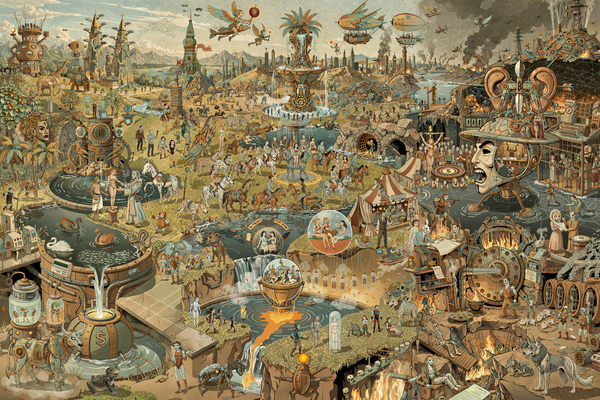
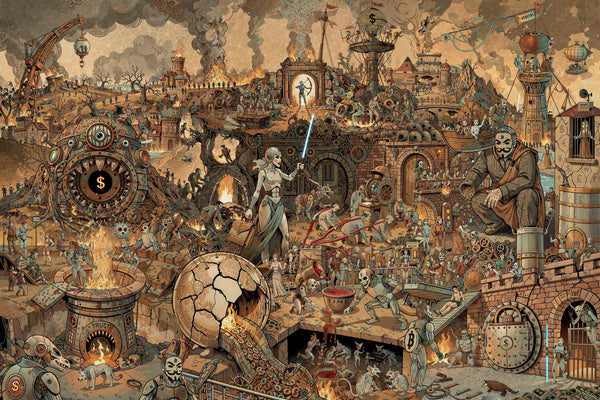
- The full Cypher Deos triptych breakdown, where this whole symbolic vocabulary goes renaissance-scale
Or start with the story behind the work.
Better money, better art, better world.

The ₿ as centerpiece: Bitcoin Certificates.

The symbol at work across 1,776 Bank Runners banknotes.
Leave a comment