

One instruction in this piece is cut into stone.
Find the arched gate standing alone on a rise near the top of the composition. It's a ruined triumphal arch, Corinthian columns, the masonry cracked and burning behind it. The opening glows white. Standing inside that light is a figure wearing a Satoshi mask, and she has a bow drawn, arrow loaded, aimed to the right.
Across the beam above her, in serif capitals:
VERIFY
Not fight. Not flee. Not believe. Check for yourself.
Everything else in this enormous burning field is a consequence of whether that instruction was followed. That's the argument. I state it once, in stone, and then stop talking about it for the rest of the composition.

This is the first of Ten Decrees, ten Bosch and Bruegel masterpieces redrawn for the fiat age, one every two weeks until the Genesis Block anniversary.
The fury, and the decree that earned it
The composition is called Furia Fiat, and both words are doing work.
Fiat is the money. Fiat is also Latin, and in Latin it's not a noun at all. It's a verb in the subjunctive: let it be done. A decree. Somebody said so, and so it was, and nobody was asked. That is not a metaphor for how the money supply works. It is a literal description of it.
Furia is the answer. Not panic, not despair. Fury, which is the correct response to being made poorer by an instruction you never saw and cannot appeal.
Bruegel painted the fury in 1563 with Dulle Griet and thought it was a sin. I keep the fury, move the sin upstream, and point it at something specific. That's the difference between a riot and a revolution, and it's why the one word cut into the gate is not burn but verify.

The woman at the center
The figure holding this composition together is a tall woman striding left to right across the middle of the field.
She is Bruegel's Mad Meg, rebuilt. Ceramic and chrome, a fitted helmet, mouth open mid-cry. In her raised right hand, a blue plasma blade. In her left, a leather briefcase with a Bitcoin symbol stamped on the flap.
Behind her, cut into a stone band over the machine wall she's passing: BETTER MONEY. The band sits above a wall of gears, and the gears carry the symbol at their hubs. Her blade rises through the frame and passes directly through the word MONEY.
Bruegel's Griet carried a sword and a sack of plunder into hell, and art historians have argued for four centuries about whether she's heroic or insane. Nobody has ever settled it, and that unresolved quality is exactly why she survived. This version keeps the ambiguity and reloads it. Her sword is a cool light in a picture made of fire, and the sack is a form of money she can take anywhere she goes.
She's not clearly winning. She's mid-stride, mouth open, alone, in a field that's on fire. That could be courage. It could be the exact behavior that got everyone here.

The exit has been open the whole time
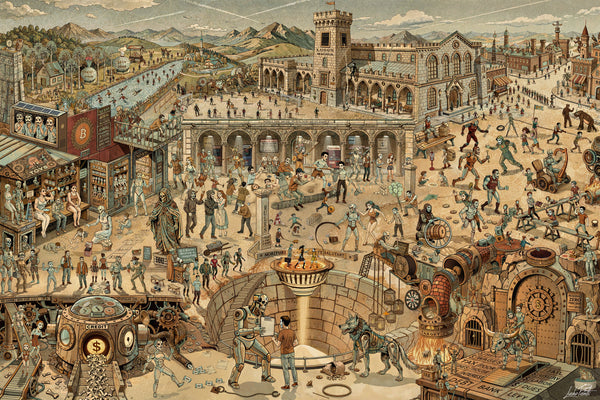
Set into a brick wall in the middle distance, upright and lit: a cabinet lettered BTC with ATM below it. Two illuminated panels glowing amber, a keypad, a screen.
Signage is an offer. A machine is infrastructure. Somebody surveyed this wall, ran power to it, mounted a cabinet, filled it, and maintains it, in a town that is on fire, because there is enough demand to justify the capital. It is the least ideological object in the composition and the most damning one.

Now look at what she is walking past.
A line of baby-faced men in worker's clothes on their hands and knees, crawling. Each is tethered by a thick red tube running from the back of the skull down to a collection point off to the left.
Then look at what they are crawling on. The ground is paved with dollar coins. Not a floor with money lying on it. A floor made of it.
They are crawling across the currency, close enough to touch, held in the one posture where nothing above knee height is visible.
Behind them the loop closes. A figure with a dollar sign on his forehead stands at a counter drawing that same red fluid from a tap and pouring it into a cup, and a skeleton with a dollar burned into its eye socket is already drinking. What comes out of the men at one end is served at the other.
The signage at the edge of the frame reads: WE ACCEPT / BTC XMR ETH. PAY WITH / crypto. 100 SATOSHI PER GLASS.

That board is what makes the crawling unbearable. The exit is not hypothetical and it is not hidden. It is lettered, lit, and a few meters from men on their hands and knees. Nobody is stopping them. Nobody is choosing for anybody.
That is the thing I keep drawing and keep failing to make anybody angry enough about. It's not a trap. There is no lock on it. The horror in these pieces has never once been that people were prevented.
A coin the size of a table
A short way along the same wall, propped among the gearwork, a single coin the size of a café table. Milled edge, worn face, the symbol cut deep into it. Three Satoshi-masked figures stand around it, each holding a glass. They are having a drink beside it, paid for in Bitcoin.
There's a version of this that's an altar: coin on a plinth, light from above, figures kneeling. I have drawn that and it is the most tiring image in this field of work, because it makes the money holy, and a holy object is one you are not allowed to spend.
Here it's furniture. It's leaning. It's worn. Nobody is looking at it.
A currency that works is not venerated. It is boring, and it is behind you while you get on with the afternoon. The gears turning around it are the part that matters, because a coin that size is not a symbol, it is a component, and the machine it belongs to is still running.
Set it against the cracked egg on the other side of the field, spilling a constant stream of dollar coins down a chute into a hole. One is a component. The other is an outflow.

Two towers, one argument
Look up.
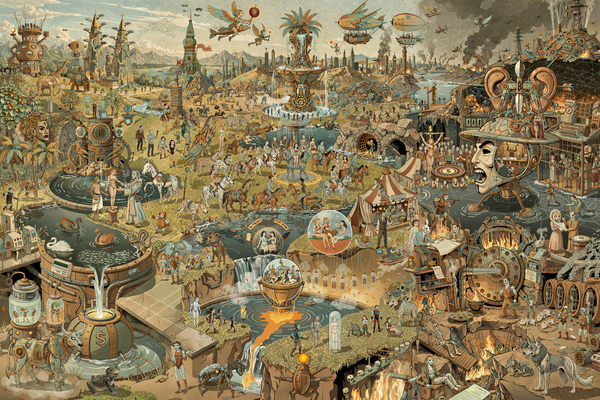
On the far right, a lattice tower carries a gridded copper sphere. From its mast flies a banner lettered VERITAS, with a Bitcoin pennant above it. A figure with the symbol climbs the rigging beneath.

On the upper center-left, an almost identical lattice tower carries an almost identical caged sphere. This one has an enormous $ on its flank, a pennant reading MENDACIUM, and a collar band around its shaft lettered INFLATION. Through a glass column above the band, granular dollar particles rise to fill the sphere.

They are matched structures. Same engineering, same platforms, same ring of onlookers. Truth and the lie, built to the same specification, plumbed into the same town.
The Latin is doing real work. Mendacium isn't falsehood in the sense of an honest error. It's deception, a lie told deliberately. Naming the dollar tower that way is an accusation of intent, not incompetence.
The giant who gives
The right third belongs to the only other figure in this field on her scale.
A giant crouching, Satoshi mask, a suit woven from circuit traces. On his right shoulder he carries a ferry full of passengers. From a brass cylinder in his arm he distributes coins down into the crowd below, and the crowd takes them. Some hold up phones. Some hold up hardware.
In Bruegel's painting the giant on the right is a plunderer. He ladles out from a vessel on his shoulder while everything around him is stripped, and what he hands over was taken from the people reaching for it.
Here he gives. Same posture, same vessel, same crowd reaching up. The only thing I changed is the direction the value moves, and it turns the most menacing figure in the original into the one thing in this field anybody is queuing for on purpose.
She walks toward the fire carrying everything she owns. He sits at the other end of it handing things out. Everybody who hasn't decided yet is in between.

The reserve burns. The pyramid doesn't.
Behind the giant, a classical building burns along its roofline with FIAT RESERVE cut into the entablature. Columns, cornice, a row of trees planted along the terrace under it. Every signal that building sends is permanence, and the roof is alight.
That architecture isn't decoration, it's a claim. Institutions build in stone to say they'll outlast you, and that your money is safe with them because they will. There's a flag on the parapet with a $ on it, and one figure standing beside the flames. Not fleeing. Not fighting it. A clown.
Bosch and Bruegel both knew what a fool was for. Erasmus wrote In Praise of Folly in 1509 and handed the entire sermon to Folly herself, because the fool is the one character licensed to say the true thing in a room full of people who can't afford to. The clown isn't mocking the building. He's the only one on it telling you what it is.
On the same ridge, to its left, a pyramid. Stone courses, a dark capstone, a ₿ cut into the face. A reserve is a promise about the future made by whoever happens to be holding the paper, and this one is on fire. A pyramid is what people build when the whole design brief is to still be standing after everyone who built it is gone, and nobody in this field is doing anything to it at all.
Fixed supply, drawn as masonry.

FARA DAY
Below the giant's knee stands a ribbed steel drum, taller than the people beside it, banded top and bottom in brass, with antenna rods bent away from the body in every direction. Across the collar, in spaced capitals with the gap sitting exactly wrong: FARA DAY.
The spacing is deliberate and it is the best part. Signage in this field is lettered by people copying a word they have heard rather than one they have read. The gap in the middle of a physicist's name is what happens when somebody knows the thing works and does not know why it is called that, which is a fair description of most people's relationship with cold storage, including some who are very good at it.
A Faraday cage blocks every electromagnetic signal trying to get in or out. Michael Faraday demonstrated the principle in 1836 by building a room lined with metal foil, sitting inside it, and having the outside charged to the point of sparking while he took readings in perfect calm. Nothing got in. The instruments read zero.
That is the entire proposition of self-custody, worked out in a London basement two centuries before there was anything to store. Put the thing inside a boundary that signals cannot cross. Then the noise outside does not matter, and the man in the room takes his own readings.
The drum is the one object in the field that is deliberately deaf, and it stands at the exact point where the distribution meets the devices. There is no signage anywhere near it explaining any of that. It is a big steel bin with a physicist's name spelled slightly wrong.

The rest of the vocabulary
The field carries several hundred figures and about two dozen lettered objects. These are the ones worth finding. I'm not going to explain them past a line each — finding them is the work, and the pleasure of this kind of picture has always been catching something rather than being told.

On the arch of a furnace burning banknotes. Look at the S. It isn't one.

A riveted bunker with camera lenses for eyes and a dollar sign burning at the centre of its throat. Banknotes spiral in and disappear.

Wages are hours. Inflation is how the claim on those hours is quietly reduced after the hours are already worked. Here they are decanted, poured out, and drunk by things that produce nothing.

Dollar issuance drawn as a shell that never stops cracking.

Look through the arch: three bombers. Soldiers is what the state calls them. The sign staked in the dirt spells out what the column is made of. The heap of empty helmets further down the field is the same men, later.

Hand-lettered across the prow of a boat. A ferry isn't a monument. It's the thing that takes you across and comes back for the next load.

Lying tipped over in the dirt beside a skeleton still wearing a breastplate lettered DEBT. Knowledge, drawn as armor, dropped. Debt, drawn as armor, still buckled on.

Three people in Satoshi masks in a glass ball above a burning town, a lantern lit in the middle of the afternoon. The most comfortable place in the composition, and completely dependent: a chain, a boom, a counterweight, and a machine somebody else is operating.

A long-snouted skull on an armored frame, a glazed port at the back with a brain visible inside, a dollar sign cast in relief like a maker's badge. Salvage, which is what the whole field is made of.
And scattered through the rest of it, without pictures, because you should have to look: a pale bird taller than the people around it with a camera lens where its eye should be, in a composition whose one instruction is verify. Placards reading SCAM and HODL and BUY. A burning notice lettered DEBT. GROKBOT on a barrel band. The small print of a society arguing with itself.
What it's actually about
Furia Fiat is organized around epistemology. Not who has the money. Who can tell what's true.
The gate says VERIFY. Two towers say VERITAS and MENDACIUM. A shield says KNOWLEDGE. Placards say SCAM and SOUND MONEY. A furnace says TRU$T. Every one of those is about knowing, not about having.
And then there's the watching, which is the same argument from the other side. The thing that used to look has been replaced by the thing that records. Camera lenses are set into the bridge masonry beside the WAR arch. Lens pods are built into the vault maw's eyes. Standing in the middle of the left-hand field, taller than the people around it, is a pale bird, and where its eye should be there is a camera lens.
A bird with a lens for an eye. In a composition whose one instruction is verify.
The proposition is that the monetary catastrophe is downstream of an information catastrophe, and that the correction runs the same direction. You don't fix the money by seizing it. You fix it by being able to check it. That's the difference between being watched and being able to look, and it is exactly what a blockchain is for.
Somebody gets out
In the last chamber, one figure is leaving.
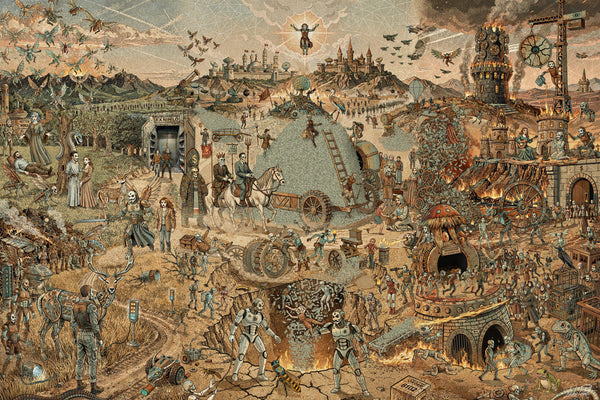
Armored, long-haired, the Satoshi mask pushed aside, walking away from the fire with a large round disc strapped across his back. The disc carries the ₿ symbol, worn as a shield is worn when the fighting is over: on the back, out of the way, still on. A shield on the arm is a defense. A shield on the back is a decision made only when defending is no longer needed.

Read the wall on his way past. Somebody has written IT'S TIME FOR PLAN ₿ on the brick in marker, beside a door that weighs more than the room. Over the archway out, cut into the stone: EXIT. And on the block beside it, in the same hand as the brick: DON'T LOOK BACK.
Every institution in this field letters its signage properly. Cut stone, cast plate, raised capitals, municipal typefaces. The three sentences that tell you what to do about any of it were written by somebody with a marker, on a wall, on the way out.

He and the woman at the center are the same figure at two points in the day. She is striding into the worst available place holding everything she owns. He is walking out of it, defenses down, and nobody is stopping him.
On the floor between the two doors: a steel backup plate, face up, stamped in the numbered slots a seed phrase gets stamped into. Read the slots. SECURE. YOUR. CRYPTO. WALLET. WITH. SAFE. SEED. STAMP. PLATES. It is the product's own sales copy, punched into the product. Nobody's keys are on it. The FARA DAY drum makes that joke at the size of a building. This one makes it at the size of a thing you could put in your pocket.
Walking between the two doors, ignoring both: a honey badger. It has been Bitcoin's totem for over a decade, for the obvious reason. Swarm it, bite it, wait it out. It goes for the honey anyway.

Living with it
This piece behaves differently at every distance.
From across a room it reads as heat. One color field, one horizon, one bright figure at the center. That it stays legible while containing several hundred figures is not luck. It's value structure, kept deliberately simple so the density doesn't collapse into mush.
From a meter it becomes a landscape you can walk. Mouth on the left, woman in the center, giant on the right, two towers arguing overhead.
From twenty centimeters it becomes an argument conducted almost entirely in nouns. VERIFY. VERITAS. MENDACIUM. INFLATION. KNOWLEDGE. TRU$T. SCAM. HODL. BUY. DEBT. FIAT RESERVE. WAR. SOUL-DIERS. SOUND MONEY. BETTER MONEY. TIME.
A collector who lives with this piece will spend the first months on the big three figures and the next few years on the vocabulary. There's a specific pleasure available here that most contemporary work can't offer: the pleasure of catching something. Not being told. Finding it. The dollar sign hiding in TRUST. The arrow loaded inside the gate. The badger's indifference to all of it.
Bruegel's sermon was that greed damns her. In Furia Fiat the greed has moved upstream. It lives in the maw, in the tower, in the ladle. The woman running with everything she can carry is not the sinner in this version, and she is not the only one behaving rationally. So are the people walking up the ridge with backpacks, the archer inside the gate, the man holding up a hardware wallet. What's rare is walking toward the mouth, and she is the only one doing that.
Every masked face in this field wears the Satoshi mask, drawn by hand, one at a time, a mask I have been drawing since 2018. Crafted, not generated.
Verify
Because you don't have to trust me, or anyone holding a ledger.
Better money, better world. But you have to check the money yourself.
Furia Fiat is the first of Ten Decrees. One piece every two weeks until 3 January 2027.
Leave a comment