


Ten Decrees
Ten paintings. Two masters. One order nobody voted on.

The next fifty-five years would forever be changed by this one sentence:
"I have directed Secretary Connally to suspend temporarily the convertibility of the dollar into gold or other reserve assets."
Temporary, for fifty-five years.
Every fiat currency on earth today descends from that one announcement. Not from a vote, not from a referendum, not from a debate. From a decision taken over a weekend at Camp David by fifteen men, announced on a Sunday night, and never reversed.
This Bosch and Bruegel Bitcoin art series is about that. Ten pieces, built on ten of the most crowded and most furious paintings in Western art, redrawn for the world reshaped by that one statement. It's called Ten Decrees.
Fiat is not a noun. It's an order.
We say "fiat money" as though fiat were a category, like paper or plastic. It isn't.
Fiat is Latin, and it means let it be done. It's the word in the Vulgate's fiat lux: let there be light. It is not a description. It's a mood: the imperative, softened into the passive, so that nobody has to be named as the one giving the order.
That's the whole trick, and it's sitting in plain sight in the name. Fiat money is money that exists because somebody said so. Not because it was mined, not because it was earned, not because a market chose it. Because an authority issued a decree.
Ten decrees. Ten pieces. Each one a decree and its consequence.
The titles run in the same grammar. Fiat lucrum: let there be profit. Fiat cinis: let there be ash. Fiat fames: let there be hunger. Nine of them are orders issued at you in the same flat institutional voice. The tenth changes speaker: Ultima fiat, let it be the last, which is the only one of the ten that we get to say.
Why Hieronymus Bosch and Pieter Bruegel the Elder
Because they had already solved the problem.
Bosch and Bruegel worked between the 1490s to the 1560s, in the middle of the first great European boom in banking, credit and commodity speculation. Antwerp in Bruegel's lifetime was the richest port in the world and the site of one of the earliest financial exchanges. Both men painted a world where the moral order had inverted and everyone was too busy to notice.
That's the same picture. It's just wearing different clothes.
The second reason is what made the work possible: both painters solved the technical problem of how to show a whole society failing at once.
A portrait shows you one person. A landscape shows you one place. Bosch and Bruegel invented a way to put four hundred figures into a single frame, each one doing something specific and legible, so that the picture reads as a system rather than a scene. You don't look at a Bruegel, you search it. You find the man crawling. You find the tiny figure being carried. You find the joke in the corner that changes the meaning of the middle.
That's exactly what propaganda needs and almost nothing else in art history offers. A single image that holds an entire economy, and rewards you for looking harder.
Every piece in this series carries that structure forward. Hundreds of figures. Dozens of objects with words cut into them. Things you will not find the first time, or the fifth.
The ten, and when each one lands
Four are after Bosch, six after Bruegel, and the two halves do different jobs.
Bosch is about appetite. He paints temptation, indulgence, and the accounting that follows. His panels are theological: there is a judgment coming and the pleasure was never free.
Bruegel is about the crowd. He takes the camera down off the altarpiece and puts it in the village. His subject isn't sin, it's everyone. How a whole population behaves when the rules stop working. Games. Proverbs. Famine. A tower built too high. Death arriving in a column.
They arrive in the order the argument needs. It opens on fury, and it closes on the one decree we get to issue back.
| Drops | # | Piece | Source painting | Master |
|---|---|---|---|---|
| Sat 29 Aug 2026 | 01 | Furia Fiat: Let there be fury | Dulle Griet, c. 1563 | Bruegel |
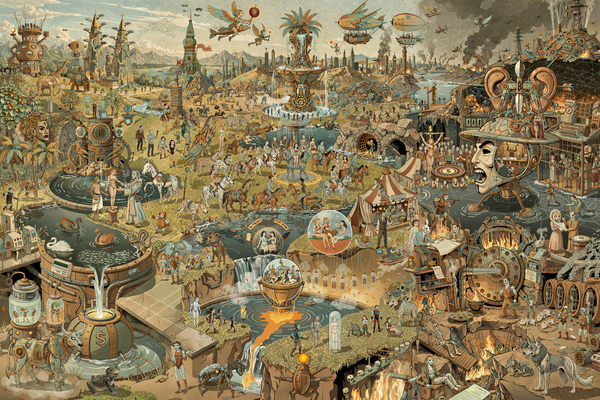
| Sat 12 Sep | 02 | Fiat Lucrum: Let there be profit | The Garden of Earthly Delights, c. 1490–1510 | Bosch |
| Sat 26 Sep | 03 | Fiat Palea: Let there be chaff | The Haywain Triptych, c. 1510–1516 | Bosch |
| Sat 10 Oct | 04 | Fiat Ludus: Let there be a game | Children's Games, 1560 | Bruegel |
| Sat 24 Oct | 05 | Fiat Moria: Let there be folly | Netherlandish Proverbs, 1559 | Bruegel |
| Sat 7 Nov | 06 | Fiat Fames: Let there be hunger | The Fight Between Carnival and Lent, 1559 | Bruegel |
| Sat 21 Nov | 07 | Fiat Refugium: Let there be a refuge | The Temptation of St Anthony, c. 1501 | Bosch |
| Sat 5 Dec | 08 | Fiat Ruina: Let there be collapse | The Tower of Babel, 1563 | Bruegel |
| Sat 19 Dec | 09 | Fiat Cinis: Let there be ash | The Triumph of Death, c. 1562 | Bruegel |
| Sun 3 Jan 2027 | 10 | Ultima Fiat: Let it be the last | The Last Judgment, c. 1482–1505 | Bosch |
Here they are, in the order the series releases. All ten original paintings are public domain and roughly five hundred years old. Mine are not shown. You get those one at a time.

Pieter Bruegel the Elder
becomes #01 Furia Fiat

Hieronymus Bosch
becomes #02 Fiat Lucrum

Hieronymus Bosch
becomes #03 Fiat Palea

Pieter Bruegel the Elder
becomes #04 Fiat Ludus

Pieter Bruegel the Elder
becomes #05 Fiat Moria

Pieter Bruegel the Elder
becomes #06 Fiat Fames

Hieronymus Bosch
becomes #07 Fiat Refugium

Pieter Bruegel the Elder
becomes #08 Fiat Ruina

Pieter Bruegel the Elder
becomes #09 Fiat Cinis

Hieronymus Bosch
becomes #10 Ultima Fiat
Three of the Ten Decrees titles are worth pausing on.
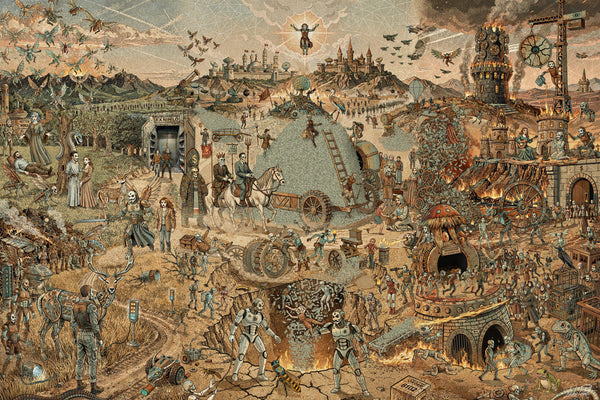
Fiat Palea is the best-sourced title in the set. Palea is chaff, and it comes straight out of Matthew 3:12 in the Vulgate: the chaff he will burn with unquenchable fire. Bosch's Haywain is a painting about a whole society clawing at a cart full of dead grass. Worthless stuff, pursued to the death, on its way to be burned. If you have ever wondered what a monetary bubble looks like from the outside, it looks like that.
Fiat Moria is a loan word, and it's deliberate. Moria isn't Latin. It's Greek, and it's Erasmus's word. He built In Praise of Folly on it in 1509, out of the same Northern humanist world Bruegel was painting in a generation later. Without Erasmus the title reads as loose Latin. With him, a wall of proverbs becomes exactly what he said it was: a catalog of folly, arranged for inspection.
Ultima Fiat closes the series, and it's the only one of the ten spoken in our voice. Translated properly it isn't "the last decree." It's let it be the last, a plea rather than an order. Nine decrees are issued at you. The tenth is the one you get to issue back.
How to read them
Slowly, and up close.

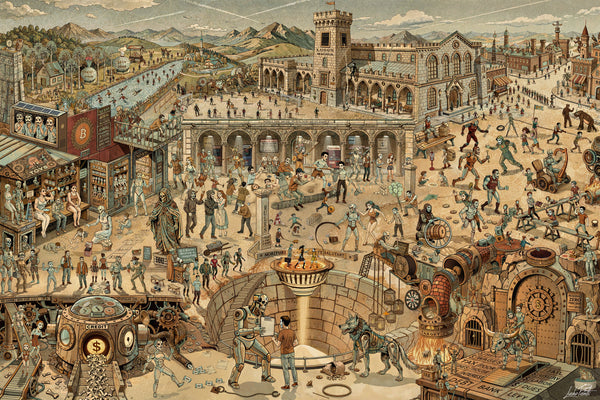
Furia Fiat: Let there be fury (Ten Decrees piece 1 of 10)
Every piece is created at a minimum of 12,000 pixels across the long side. Printed at 30 x 20 inches that's of 400 pixels per inch, which means the print holds detail your eye can't resolve from across the room. That's not a technical brag. The point is that these are artworks that need to be walked up to.

Scattered through each one are objects with words cut into them. Not captions. Objects. A word carved into a gate lintel. A word on a burning sign. A word on a banner lying face up in the dirt where somebody dropped it. In the opening piece there are over 30, like the gate with VERIFY cut into the stone above it and an archer standing inside, arrow loaded, aimed at whoever is standing there reading the word.
Don't trust. Verify. It was never a suggestion.
I'm not going to list all of them. The pleasure of this kind of image has always been catching something rather than being told.
The schedule
The series is announced on Saturday 15 August 2026, fifty-five years to the day since the decree it is named for. The first piece, Furia Fiat, goes up two weeks later on Saturday, August 29th. One arrives every two weeks after that until Sunday, January 3rd 2027, the anniversary of the Genesis Block.
It opens on the day the current money was born and closes on the day its replacement was. Between those two dates there are ten decrees.
Each piece arrives as a physical print. The opening piece is Furia Fiat, after Bruegel's Dulle Griet, and it goes up first because it's the whole opening argument in one panel: the machine, the panic, the crowd, and the exit. I'll publish a full written breakdown of every one, object by object, and what I changed from the original and why.
Every piece prints at 30 x 20 inches, signed and numbered. Ten of them hang as a block four meters wide and a little over a meter tall. That is the size the series was made for.
Why now
The thing announced in 1971 as temporary is still running, and it has produced exactly what an unbacked money always produces: an economy that rewards proximity to the printer and punishes everyone who is paid last. That's not a conspiracy, it's a mechanism, and Richard Cantillon wrote it down in the 1730s. The money enters at a point. Whoever is closest to that point spends it before prices adjust. Everyone else gets the same currency later, worth less, and calls it inflation as though it were weather.
Bitcoin's answer is not a better decree. It's the absence of one. Twenty-one million, fixed, with no committee that can vote otherwise and nobody to petition. There is no weekend at Camp David that changes it. That is the entire proposition, and it is why I've spent five months drawing what the alternative looks like when it fails.
Better money, better world.
Run before it's too late.
Leave a comment