

Fiat is Latin for let it be done. A decree, issued once, with nobody asked. Lucrum is gain. It's the root of lucrative, and in Latin it already carried the smell of profit taken rather than earned.
Fiat Lucrum. Let there be profit.
That's the sentence the entire right half of this artwork is a consequence of. Somebody decreed a gain into existence. The gain was real. It just wasn't theirs, and it wasn't new, and there's a glass tank in the middle of the lake where you can watch it being poured out for the people inside.
It's built on Bosch's Garden of Earthly Delights, painted around 1500 and still the best-engineered argument in Western art: paradise on the left, the party in the middle, the price on the right. Bosch made the temptation beautiful so the judgment would hit harder. I kept his structure and made it about the money.
Bosch has been in my work for years and this is the most direct I've ever been about him.

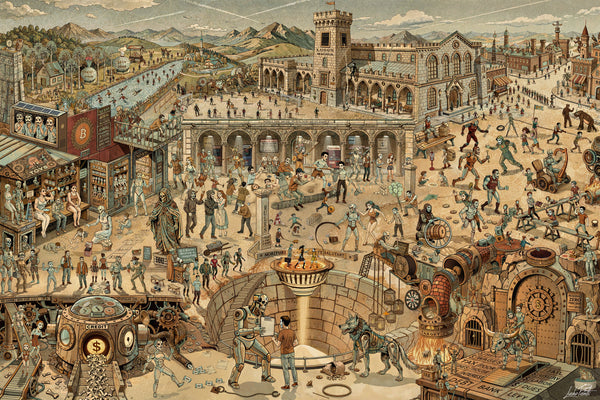
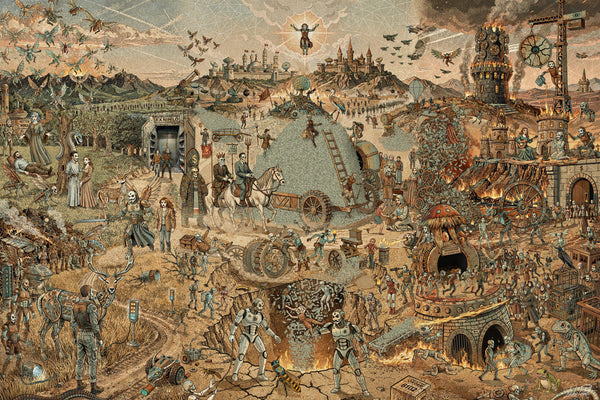
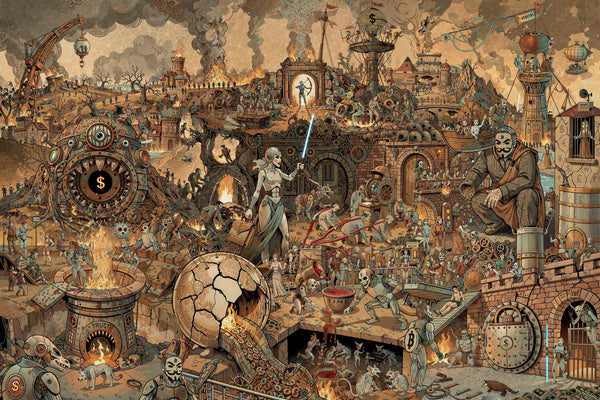
What Bosch never had is plumbing. Water organizes this entire canvas. It starts clean in the upper left, high in the mountains. It pours out of a machine in Eden and gathers in a reflecting basin you can see into through a viewing window. It widens into a lake across the middle. Somewhere in that lake a tank springs a leak, and from there the water runs orange: down a stream, over a waterfall, into a pool where things drink it. Past that it's gone, and where it's gone there's fire.
Where the water is clean, there are animals and a birthday. Where it leaks, there are parasites. Where it's dried up, there's a casino and a furnace.
Three panels. Paradise, the party, the price.
Paradise
The paradise here isn't innocent. It's built, and it belongs to somebody.
Look at the cliff on the far left, because there's a face in it. A colossal head in profile, worked into the rock, wearing the Femme Satoshi mask.The cranium is open. There's an exposed movement in gold and brass, gear trains and wiring laid out the way a clock is when the back is off.
Now set it against the object in the equivalent position on the far right: an enormous cracked head, mouth open in a scream, hollow, with a high-stakes poker game where its brain should be and a $ on its brow. One is opened so you can see the mechanism working. The other is cracked open and there's nothing inside it but a game. That pairing is the spine of the whole composition, stated in two skulls at opposite edges of the canvas, and the two brow marks tell you which is which.
Growing beside the head, at the very edge of the canvas, there's a strawberry tree. That's the oldest name for Bosch's painting. The first Spanish records of the triptych, in the 1590s, don't call it a garden at all. They call it la pintura del madroño, the strawberry-tree painting, after the giant fruit his center panel is full of. Mine grows at the source, upstream of everything, and the strawberry comes back in the middle of the lake with three women sitting on it.

The man in the dewar
A few paces down the slope from the head, in the grass beside an orange tree, there's a steel cylinder on a stand. It's a cryonic dewar, the kind that holds a body in liquid nitrogen. The sign above it reads HAL FINNEY. The body of the vessel reads running bitcoin.
On January 11, 2009, Hal Finney posted two words, "Running bitcoin," and became the first person other than Satoshi to run the software. The next day he received the first transaction ever sent on the network, ten coins from Satoshi, in block 170. When he died in August 2014 his body went to Alcor in Arizona to be preserved. He's still there.
I put him in Eden on purpose. This panel has a birthday, and he was at it. The dewar is the only object in the garden that's also a grave, and it's the only grave in the piece that isn't a punishment. Everything on the right dies of what it did. He's on ice because he wanted to see how it turns out.

The creation of Eve
Standing at the pool's edge, a figure in a white monastic robe and the Classic Satoshi mask holds the hand of a woman standing on a low pedestal. She's an android, joints visible at the elbows and knees, in the Femme mask, the ₿ on her brow. It's Bosch's Creation of Eve, exactly, with the mask where the face of God should be.
The pedestal she's standing on is lettered. ECCE NOVA on the front. BEHOLD the NEW on the side. Behold the new: a new kind of money, presented to a man who's already reaching for it.
Adam stands to the left of the pedestal, bearded, bare-chested, reaching toward her with an open hand. He wears the Classic mask too. Two men in the same mask are transacting over a woman in a different one, and she's the one on the plinth. Bosch indicted everybody in his garden. So do I. The scene isn't a wedding. It's a presentation, and the person being presented is the product.
Out in the meadow beyond the basin, a masked figure in an ordinary hoodie walks toward the party with an orange in one hand and a banana in the other. The hoodie reads better money since 2009. That's the theology of the panel in three words and a date. This Eden has a birthday.

The water you can see through
The water in the reflecting basin is transparent. And cut into the basin's outer wall, at eye level, there's a glazed inspection window with fish visible behind the glass.
Somebody built a viewing port into the reservoir. You're meant to be able to check.
Hold that against the lake downstream, which is opaque, and the orange spreading across it, which you can only see the top of. Same substance, two treatments, one you can inspect and one you can't. Sound money is auditable. You don't have to trust the reservoir. You can look into it. Every full node on the Bitcoin network is that window, and it's the same principle my on-chain work runs on.

Now read the two instruments bolted to it. On the rim, a round gauge with the needle pinned in the green: UP! PROFIT 10000X ROI. At the far left of the basin, a blue console screen attended by a masked android, and the screen says one word: LIQUIDATE. The promise is on the dial. The execution is on the console. They belong to the same machine, and they're bolted to the only honest water in the piece.
Look up
Then look up. Start at the sky and count the numbers.
Airships drift across the upper band of this piece and their flanks are lettered. One says 3.125 BTC. Another says 1.5625 BTC. Back on the left, a clock tower carries 50 BTC on its face, a domed rotunda in the far distance is marked 25 BTC, a pennant on a spired tower reads 12.5, and a roadside sign in the grass says 6.25 BTC. Above the smoke on the right, on a small winged glider ridden by one masked figure, the series ends: 21,000,000.
That's the Bitcoin issuance schedule, laid across the composition as physical objects. The single most abstract fact about hard money, that its issuance is cut in half on a fixed schedule until it stops, drawn as vehicles you can watch recede from the mountains toward the smoke, ending with the cap.
Then look higher, at the crowns of the two great towers on the left. Each carries a lettered mast plate. The left one reads 100,000,000. The right one reads SATOSHIS.
The two tallest structures in this Eden spell a single bitcoin. Everything drifting below them is denominated in that unit. The sky isn't decorated. It's a monetary system with a numerator and a denominator, and it's been built as architecture.

The party
Where the clean water goes
Follow the outflow. The clean water leaves the basin, falls, and lands on a riveted steel globe with a $ on its face.
That's the fiat water cycle, and it's the mechanism behind every complaint in this essay. Richard Cantillon worked it out before 1755: new money isn't neutral, because it doesn't arrive everywhere at once. Whoever stands nearest the tap fills their glass while the water is still clean, and everyone downstream gets what dribbles out of the pipes. The globe doesn't make water. It positions itself under the flow and calls the pool on top of it wealth.

The product line
Beside the globe, on brass pedestals in the grass, stand two bell jars. They're the system's product line.
The first holds a skull in amber fluid, a feeding tube running into it, the $ on its forehead. The plate on its pedestal reads BATCH 13. The Federal Reserve Act was signed on December 23, 1913. Everything the right half of this canvas does is a later batch of the same product, and the first one is being kept alive in a jar in paradise.
The second is a music box. Three dancers turn inside a glass jar, and a butterfly wind-up key with a $ medallion sticks out of the side. The dollar winds the box. The band around the base reads KEEP DANCING.
In July 2007, with the credit markets already cracking, Citigroup's chief executive Chuck Prince told the Financial Times: "As long as the music is playing, you've got to get up and dance. We're still dancing." The music box is that sentence as an object. Somebody else holds the key, and the dancers don't get to stop.

Bread, circuses, and a ring of fire
On the stem of the great fountain at the top center there's a circular platter with a raised rim, and the rim is lettered. PANEM ET CIRCENSES on the left. A $ boss at the front. BREAD AND CIRCUSES on the right. On the platter, a ring of children in skull-faced masks runs a circuit around a jet of water. Out over the lake a drone lettered FOOD DELIVERY is dropping loaves. The bread arrives by air, and the circus runs on a plate with a dollar on its lip.

Around the fountain circles the cavalcade. Bosch drew a ring of men on animals circling a pool of women. Mine is a ring of riders in the Satoshi mask on cyborg horses, and at least one saddled horse in the ring has no rider at all, reins looped, stirrups ready. That seat is yours. The procession isn't a parade. It's people leaving with what they can carry, past the thing at the center.
And at the center, at almost exactly the midpoint of the canvas, there's a ring of fire on the ground with a field of crumpled dollar bills inside it.
Standing in the money is one animal with two heads, a bear's and a bull's, one body, ₿ roundels on both flanks, and a barefoot rider between the heads with the ₿ on her brow and reins in hand. Same body, same brand, same owner. Whichever way it runs it runs on the same track, and the house takes the spread either way. It's standing in a ring of burning cash at the center of a piece called Let There Be Profit because a market denominated in something that burns doesn't have an up. The rider is one of mine, and that's not an accident. Bosch's center panel is the tempted, not the tempters, and the temptation at the middle of this garden is the ride.

Three spheres
Bosch sealed people inside glass bubbles in his center panel, enjoying themselves in something that could break. There are three on my lake, and everyone inside them wears the ₿. One is the strawberry. Three women sit on a giant berry inside a glass bubble, the ₿ on every brow. One drinks. One fans out a hand of bills. The one in the middle holds up a hand mirror, and the face in the mirror is a skull with a dollar on it. Pride, pleasure, profit, and a built-in expiration notice, which is what every one of these spheres has. And the third one is the hinge of the entire piece.

Fresh liquidity
A glass-domed tank stands on a brass pedestal in the lake. Its rim band is engraved FRESH LIQUIDITY. Its bowl is lettered BOTTOMLESS. On top of the dome, outside the glass, there's a brass gate valve with a hand wheel. Inside, eight people with the ₿ on their brows are having the party of their lives. And at the front, one woman looking straight out at you, because she's worked out what the floor is doing.
The floor is leaking. Orange fluid gushes out of the base of the tank, spreads across the lake and drops down the waterfall as a band of orange in the clean water. This is the hinge. Not an invasion. Not a war. A liquidity injection. Something added to a system that was fine, by people who are enjoying it, and the poison is the addition. Nobody comes to take your savings. They print more of what you're holding and hand it to somebody else first, and the stain is poured in from a tank labeled fresh.
The valve is the detail I'd point at. The wheel that controls the flow is outside the dome. Nobody at the party can reach it. Monetary policy is set outside the tank by people who aren't wet.
The alternative is the least dramatic thing in the frame: a supply nobody can add to. Twenty-one million, and no valve.

Downhill
Follow the orange. It leaves the tank, crosses the lake, drops over the falls and pools at the bottom, and the animals down there are a thesis in three bodies.
A tick the size of a dog stands at the edge of the orange pool: a corrugated proboscis, a gold compound eye, a $ on its cheek, and a round sight glass in its shell that shows the fill level. The proboscis is in the pool. The sight glass is orange. It's drinking the leak, and you can see how much it's had.
Nearby a scarab with the ₿ on its back holds a solid orange orb between its horns, glowing, the way the Egyptians drew Khepri rolling the sun into the sky each morning. The scarab doesn't drink anything. It carries the thing it made. That's proof of work as a beetle. It rolls its block.
And back up by the dollar globe, a frog. Its plates are engraved like a banknote and its eyes are lenses, and its tongue is out, taking an insect out of the air. A woman in the mask stands at the pool's edge pointing back at it with one hand and making an OK sign with the other, while the tick drinks behind her.
Honest work feeds the frog. Leaked money feeds the tick. The scarab builds. Nothing in the piece says that in words. Three animals say it in what they eat.

The casino at the water's edge
On the shore beyond the cavalcade there's a tent, and it's lettered. CASINO over the door. A WIN pennant on the pole. Behind the counter, two croupiers with $ skulls for heads. Out front, a man in a waistcoat and the Classic mask holding up a ₿ coin, and on the cashier's cage behind him a small sign that says NO CRYING IN THE CASINO.
Somebody has opened a business at the edge of the party, which is exactly what happens at the top of every cycle. The customer is one of mine, coin in hand, about to sit down.

The price
The hell of this piece isn't a torture chamber. It's a trading floor with an industrial estate behind it. Hell here isn't demons and pitchforks. It's the financial system.
Its central figure, standing where Bosch put the Tree-Man, is an enormous cracked head, mouth open in a scream, hollow, a $ cut into its brow. Where the Tree-Man's tavern would be there's a glass observation sphere, and inside it, a high-stakes poker game. The players are skulls with dollars on their foreheads. One seat is taken by somebody in a plain white mask, which is how you get a seat at that table.

In front of the head, in the middle of the worst panel in the piece, a crowd has assembled on purpose: dozens of people in the Satoshi mask cheering a woman who holds up a golden staff, while someone at the back raises a red placard. The staff is topped with a $. The placard says ETF.
On January 10, 2024, the SEC approved the first spot bitcoin exchange-traded funds in the United States, and people who'd spent fifteen years telling everyone to hold their own keys lined up to buy a dollar-denominated paper claim on the thing they already owned. That's this crowd. They wear my mask, they walked all the way to the casino, and they're cheering a dollar on a stick because it has the right word on the sign.
The paperwork
Two figures sit at a desk with a fire behind them. The one selling wears a gray suit, a red tie, and for a head, the skull of a rabbit with a $ on it. The one buying wears a tan suit, the Classic mask, the ₿ on his brow. Between them a large document, legible from across the room: 3X. -99%. LIQUIDATED. CROSS LEVERAGE. Hung from the desk's front, a small hand-lettered sign that's the most quietly savage line in anything I've made:
genius
we print
you pay
have a nice day
Nine words. That's the entire fiat system, and it's the easiest thing in the piece to walk past.

A few paces to the right, the same rabbit skull is on its feet, handing a sheet headed MORTGAGE to a woman with the ₿ on her brow. The seller is at both desks. The buyers are mine at both.
The presses
Along the back wall, under a rock overhang, four barrel-shaped housings stand in a row, and there's a press console in each one with a $ on its face. The barrels are lettered QE-1, QE-2, QE-3 and QE-∞. Bills are spraying out of the tops.
Three piggy banks lie on the floor in front of them, each with a wire running out of it, and the wires run into the press intakes. The pigs are lettered SAVINGS, PENSION and NEST EGG, and NEST EGG is cracked open and empty. A skull with a dollar on its forehead is tipping a jerrycan into QE-∞. The jerrycan is stenciled DEBT.
Those are real names. The Federal Reserve announced the first round of quantitative easing on November 25, 2008. The third, in September 2012, was open-ended, which is when traders started calling it QE infinity. On March 23, 2020, the Fed dropped the pretense of a number and said purchases would be unlimited. The presses run on purchased debt. That's not a metaphor, that's the mechanism, and it's what the can says.

The incinerator floor
Dominating the floor, a furnace with a round door the size of a house and a legend cast into the plating above it: VALUE INCINERATOR. A pipe stuffed solid with cash feeds into its side. A brazier beside it burns, marked TOXIC DEBT. A round table with a $ at its center is laid with tarot cards, a candle, a red button and a book titled BOOK OF SPELLS, because monetary policy at this end of the room is a séance. Past it, a shredder eats sheets headed TERMS AND CONDITIONS, and its front is stenciled SUBJECT TO CHANGE.
And walking through the middle of it, unhurried, one man who isn't part of the machinery. Classic mask, the ₿ on his brow, a BTC patch on his vest. In one hand a lit lighter. In the other a bag stenciled BURN BAG, DESTROY BY FIRE, the kind governments use for paper nobody's meant to read again. Everyone else in this room is feeding the incinerator. He brought his own fire, and he isn't afraid of the furnace.

The cage
One of the cages needs its own paragraph. Inside it, with the prisoners, there's a small table, and on the table a painter's palette loaded with color and a jar of brushes. Behind it, on an easel, a canvas with a ₿ on it.
That's me. Not a portrait, an inventory. The tools and the subject, behind bars, in the hell panel, next to the incinerator. I don't paint, I draw, but a palette is what a cage recognizes as an artist, so that's what's on the table. The one job in this composition that isn't producing, gambling, signing or burning is making the artwork of it, and the system put that job in a cell with the rest of us. I'd rather show you that than pretend the artist stands outside the frame.

The cruise ship
Out past the smoke, on the water, there's a cruise ship.
Fully lit, decks stacked, every window on, moving across the bay at an unhurried angle. Behind it the shoreline is burning, a tower lettered BANK alight. The liner is not in trouble. It isn't evacuating anybody. It's on a cruise.
This is the most cynical object in the composition and the one I'd defend longest, because it's the only thing in the right panel that's comfortable. Everything else over there is a failure state, and failure states are easy to draw and easy to dismiss. A leisure vessel with the lights on, passing a burning coast at cruising speed, is harder to look at, because it isn't a failure. It's somebody's excellent evening.
Every monetary collapse in the record has looked like this from the deck of something. Weimar had nightclubs, and the people in them were doing better than they'd ever done. The people closest to the printer don't suffer during a debasement. They have the best years of their lives, and the whole grievance of the Cantillon effect is that the two experiences happen in the same week, in sight of each other, to people who could wave.

An honest reading
Treat a work this legible as a diagram and you'll misread it. The diagram version says: hard money is Eden, fiat is hell, choose. I'll let you say that. But the piece does three things that complicate it, and the complications are where it actually lives.
One: the fall is voluntary and pleasant. The people in the tank are having the party of their lives. There's no serpent in this garden, or rather, the serpent is a very appealing offer that everyone accepts, and its name is on the tank: fresh liquidity. The catastrophe is something added, not something taken. That's Cantillon, drawn.
Two: the mark is on both sides. The buyer at the leverage desk wears it. The woman signing the mortgage wears it. The crowd cheering the ETF wears it. If the ₿ were a badge of salvation it wouldn't be distributed like that. It marks who lives in this world, and the $ marks who's running it. Bosch drew his own neighbors into the center panel. I drew mine.
Three: hell is boring. It isn't demons and pitchforks. It's a poker table, a mortgage form, a shredder for the terms, four money presses with names, and a furnace with a sign on it. The worst place in this piece is the financial system. Anyone who's read a margin call understands the choice.
The one thing I won't over-claim is the ending. The right panel doesn't resolve. The man with the burn bag is still in the room. I'm not promising you a way out. I'm showing you the plumbing, giving you a window to look through, and letting you decide whether you want to be upstream.
Crafted, not generated
Every mask in this piece was drawn by hand. Hundreds of them, in two designs, the Classic Satoshi and the Femme, across the cavalcade, the casino, the cages, the rally, the desks. Where a ₿ sits on a brow it was placed one at a time, at a size you'll never see unless you go looking for it. A stamp would have been faster, and it would have shown.
Bosch's garden has no words in it. Mine has more than fifty lettered objects, from the seven numbers of the ladder to the four lines on the broker's desk, and every one of them was drawn.
A machine can put letter-shapes on a surface. It can't decide that the valve goes outside the glass, or that the pigs get names, or that the seller has a dollar on his skull at both desks. That's what the phrase means. Not that a hand touched it. That somebody chose.
Why it holds up over years
Density isn't the same as reward. Plenty of crowded compositions give up everything in one long look and have nothing left afterward. This one is structured to release slowly, and the structure is what makes it worth living with.
The first pass is the landscape. Towers, fountain, lake, smoke. It reads whole from across a room.
The second pass is the story. Source to drain. The ladder receding. The tank leaking. The presses. The incinerator. You can walk a guest through it in ten minutes and they'll remember it.
The third pass is the text, and the third pass never ends. Some of it you can read from the doorway and some of it you can't read at all until you lean in. KEEP DANCING. BATCH 13. NO CRYING IN THE CASINO. QE-∞. SUBJECT TO CHANGE. genius, we print, you pay, have a nice day. You'll find new sentences in this composition in year three. That isn't a marketing claim, it's a consequence of how it was made.
And at the top of the watercourse, the frog. Built, like everything else here. Banknote plates, lens eyes, tongue out, taking an insect out of the air a few feet from a globe that's calling somebody else's water its own. It doesn't drink the leak. It doesn't need the valve. It eats what it catches, and it's still eating while the incinerator runs.
Whatever else I believe, I believe that.
Better money, better world. Stay upstream.
The print. 30 x 20 inches on Hahnemühle German Etching 310gsm. Signed and numbered, edition of 10, $600. Certificate of authenticity timestamped on Bitcoin. The edition is open now. See the print.
Fiat Lucrum is the second of the Ten Decrees. The first, Furia Fiat, is where the argument stops being drawn and starts running.
Leave a comment