

Fiat is Latin for let it be done. A decree, issued once, with nobody asked. Moria is folly. It's Erasmus's word. In 1511 he published Moriae Encomium, The Praise of Folly, a book where Folly herself gets up in front of everybody and spends the whole time praising herself. Her case is that the world would grind to a halt without her, because nothing runs without people willing to believe what they're told.
Fiat Moria. Let there be folly.
Money only works as long as everybody agrees to believe in it. That's the decree this piece answers: a currency that can be printed without limit, held up by the thing Folly says she's always been best at, people agreeing not to look too closely.
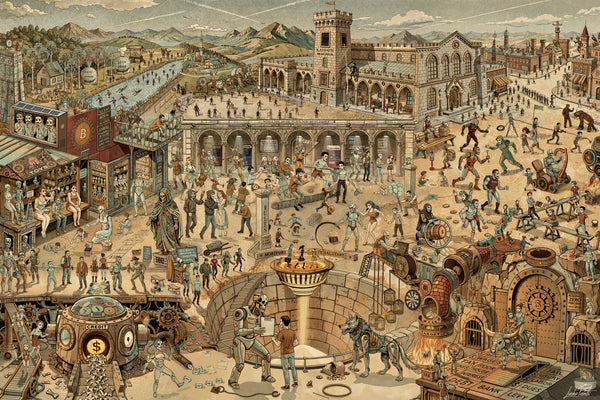
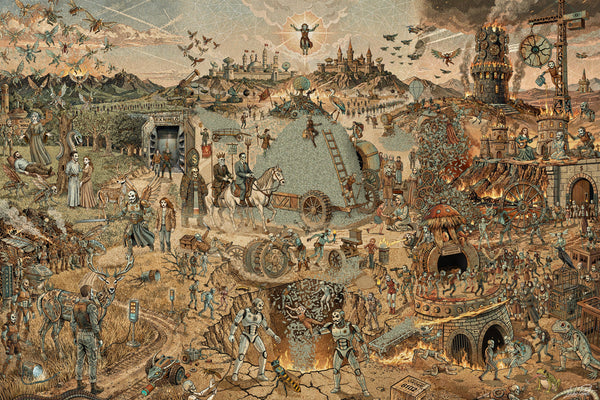
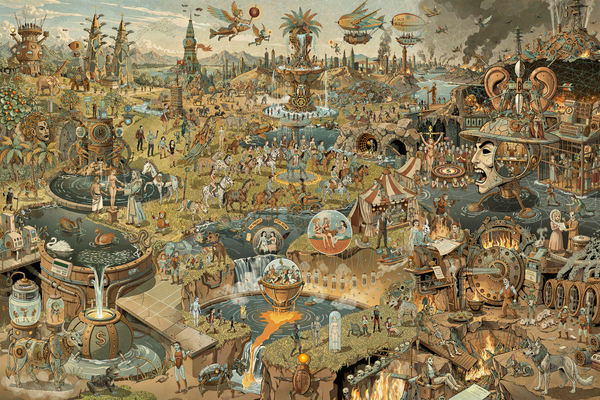
Fiat Moria is built on Pieter Bruegel the Elder's Netherlandish Proverbs, painted in 1559. Bruegel packed a Flemish village with over a hundred proverbs, acted out literally and all at once. A man bangs his head against a brick wall. Another fills in the well after the calf has drowned. A woman hangs a blue cloak on her husband, which meant she was cheating on him, and a man holds a candle up to the devil. The painting's old title was The Blue Cloak, or The Folly of the World.

Mine keeps the village and the crowd, and every proverb in it still means what it meant in 1559. What changed is who runs the place. The ones in charge are skulls with a $ on them, and the folly they keep going is the money system.
The world, upside down

Bruegel hangs the world upside down on an inn sign with a globe and its cross pointing down, symbolizing that the world is turned upside down, everything the opposite of what it should be.
In the middle of mine, a $ skull leans out of a window over a large banner with the world hanging upside down too. The continents are flipped, with a $ at the center. On one side of his window, a plaque reads Mundus vult decipi: the world wants to be deceived. On the other side, a second plaque reads $tultorum infinitus est numerus, the number of fools is infinite, with a $ standing in for the S.
That's the rule this village runs on. A fiat dollar has nothing behind it except the promise of more dollars. It holds up on belief, and belief is renewed for as long as people would rather be told everything is fine.

Under the banner sits Bruegel's title scene. A smiling young woman stands behind an old man on a stool and pulls a blue hood down over his eyes with CPI printed across it. He sits there with his hands folded over his purse. The plate along the edge of the stage reads PULLING THE BLUE CLOAK OVER THE EYES.
The Consumer Price Index is the number that tells him how much his money lost this year, and his raise, his pension and his Social Security check all get adjusted by it. From under the hood he can't see the prices. He only gets the number.
Behind them, a machine marked PRINTER pours bills down a chute into a basket. Beside the stage, a $ skeleton in a pinstripe suit holds up a sign that says It's a SCAM. Nobody on the stage looks at him. He's just criticizing Bitcoin.
The church of credit

Credit comes from the Latin credere, to believe. Credo, I believe, is the first word of the creeds. So the village has a church for it.
Five copper letters spell CREDO across the arch of the shrine. Inside sits the idol, a horned $ skull on a seated stone body with one hand over its heart and a $ hanging where a halo would go. The two pillars that hold the arch up are lettered DEBT and FEAR.
Kneeling in front of it, a young man holds up a tax form. The brass plate under the idol asks the question every bank asks before it lets you touch your own money: SOURCE OF FUNDS? Bruegel has a man confessing to the devil, which meant handing your secrets to your enemy. This one does it on a form.

Just below the shrine is the vault. Its doors are lettered WE PRINT / YOU PAY, beside a brass TREASURY plate and a bronze eagle on a beam that reads FEDERAL RESERVE. Two masked runners are on a chain, held by a horned $ skull with FIAT on his vest.
In front of them, a smiling banker in a brown suit bows low with a lit candle in his hand. That's Bruegel's man holding a candle to the devil, flattering anyone if there's something in it for him.
WE PRINT and YOU PAY is the whole arrangement in four words. New money comes off the press at the top, the people closest to it spend it first, and everybody else pays for it later at the register.
The fountain

At the center of the village, where Bruegel's square would have its well, there's a fountain, and sitting in it on a wooden throne is a horned $ skull robot. His feet are in the water with bills floating around his ankles, and he holds up a small globe on a stick lettered DEBT.
By his foot, a sack marked TARP $700 BN is going under. Bruegel's proverb is filling in the well after the calf has drowned, doing something only once the disaster is over. TARP was signed into law on October 3, 2008, eighteen days after Lehman Brothers filed for bankruptcy.

Down at the base of the fountain, a worker in an apron holds his liquid SAVINGS in a sieve, and it runs straight through into a pot marked INFLATION TAX. Behind him, lining the outside of the well are heaps of skulls, every one with a $ on its brow, and a panel on the right that reads MEMENTO MORIA. Memento mori means remember that you'll die. This one says remember the folly.
Saving in a money that's built to lose value is carrying water in a sieve. The Fed's target is 2% per year, and it calls that price stability. At 2%, a dollar loses half its buying power in 35 years, which is roughly a working life.

Off to the side, the village barber is at work. Bruegel's proverb is shaving the fool without lather, which meant tricking somebody. Mine is a $ skull in a pinstripe vest who skipped the razor and went straight for the blush. The customer wears a jester's cap and a name tag that reads FOOL, and he's smiling while the barber does his cheeks. The round platform under the chair reads TAKE IT AT FACE VALUE.
Face value is the number printed on a bill. It's the only number on it that never changes.
Contained

The shelves above the square keep the 2008 crisis on file.
A crate on the top shelf reads SUBPRIME: "CONTAINED", 28 MARCH 2007. That's the day Ben Bernanke told Congress's Joint Economic Committee that the problems in the subprime market seemed likely to be contained. Under it sit two plates, PRIVATE GAINS on top of a bigger one, PUBLIC LOSSES. Next to them is a crate of manure stamped AAA RATED. Bruegel's proverb is that horse droppings aren't figs, so don't be fooled by appearances. The rating agencies gave their top grade to mortgage bonds that turned out to be exactly what's in that crate.
Further down the wall, SAVE AND LOSE and BORROW AND WIN sit on either side of a $ medallion, beside a coin with two faces looking opposite ways. A plate reads DUAL MANDATE, EST. 1977, FED ACT, next to MAX EMPLOYMENT and 2% INFLATION. The Federal Reserve Reform Act of 1977 told the Fed to promote maximum employment and stable prices. 2% inflation is what stable prices turned into.

Up the hill, a shed with a boarded-up window has a NOTICE OF DEFAULT on the door and a BANK OWNED sign across the front. The crates beside it are lettered FANNIE MAE and FREDDIE MAC. Behind the shed rises a cracked dome reading LEHMAN BROTHERS, EST. 1850, with FAILED 2008 around its base. A $ skull walks off its balcony carrying his things in a box while papers stamped TOXIC and AAA blow out of a vent, and the box below reads CREDIT DEFAULT SWAPS.
Under it, a small round car marked TIME MACHINE, NO RETURN shows 1944-2026 on its dial. 1944 was the year of Bretton Woods, when the world's money was tied to the dollar.

Behind the plaques, out by the cornfield, a gate stands open under a sign that reads GLASS-STEAGALL, and a pig walks through it to join the rest of the herd in the corn. The Banking Act of 1933 kept commercial banks out of the securities business. The part that kept them apart was repealed on November 12, 1999.

In a window over the printing press, a skeleton cranks a roller above a plate that reads WE'RE NOT PRINTING MONEY, BEN BERNANKE, 5 DEC 2010. He said it on 60 Minutes, a month after the Fed announced it would buy another $600 billion in Treasury bonds with money it created to buy them.
The bills come off his press down a chute into a wicker basket. Below them sits a crate of OFFICIAL EGGS stamped GRADE AAA, next to a box marked GOOSE, and a sign on the machine promises NO FEES*.
The mint

The left side of the village is the mint, and it runs on a slide. Coins stamped with a $ roll down a long wooden chute into a vat lettered DEBASED, and a column of paper bills pours out of its bottom straight into a round PUBLIC TROUGH where pink pigs feed. A $ skull android keeps his hand on a button marked MORE, and a mechanical griffin with a $ on its brow spews bills from its beak.
Debasing is the old version of the trick. Kings clipped silver off the edges of their coins or mixed in cheaper metal, and spent the difference. The coin kept its face and lost its weight. Paper did away with the weight altogether.

On the boardwalk below, a horned $ skull in a long robe carries a glass globe with a $ inside it, the world shrunk to fit in one hand. Behind him, a $ skull clerk has a white goose on his bench and two eggs on the belt in front of him, and a skeleton android walks off with another goose under its arm.

At the foot of the trough, a $ skull in a top hat kneels with a syringe marked with a $, next to an open doctor's bag of vials and two strongboxes chained together. Nearby, an old woman kneels with a bowl and a spoon, scraping up the porridge from the pot she tipped over. Bruegel's proverb is that whoever has spilled his porridge can't scrape it all up again. Bills drift down through the grate above her head.

On the far left, the edge of an awning reads THE BROADEST STRAPS ARE CUT FROM SOMEONE ELSE'S LEATHER. People are generous with other people's money. It's still the most honest description of a government budget I've read.
Below it, a gas lamp burns on a base marked 2%, beside a wall that reads GASLIGHT. Gaslighting is telling somebody that what they see isn't real. Prices go up at the store, and the lamp keeps saying 2%.
At the edge of the frame, a masked runner with 6.15 on his chest raises both hands, one holding a brass key with a Bitcoin on its bow.

Upstairs, a funnel lettered THE FED'S FAVORITE PROMISE spits DEBT slips into the air, under a cracked half globe that reads SOFT LANDING. In the window next door, a $ skull looks over a DEBT notice while the keypad on his ledge reads NO FUNDS.

Around the corner, a giant pair of scissors hangs on the wall over SNIP SNIP, and a small box reads BUY NOW PAY LATER. Through a window lettered QUANTITATIVE EASING, a $ skull leans on the crank of another press. Quantitative easing is the long name for creating money to buy bonds.
The water

On the right side of the village, a masked courtier in a green coat and a tricorn hat stands at the top of a stairway and flicks his coins away. Bruegel's proverb is throwing your money into the water. The stair rails read NO VALUE and NO RULES.

Next door, under a stall sign that reads BIG FISH EATS LITTLE FISH, a masked woman has a small winged $ devil tied to a cushion with rope. Bruegel's proverb is that she could tie even the devil to a pillow: stubbornness beats everything.
Bruegel drew Big Fish Eat Little Fish in 1556, three years before the Proverbs. In mine, the big fish leaps out of the river with its teeth bared, and out on the water a $ skull in a rowboat hauls in a net full of the little ones.

Across the river, a stall sign reads ₿ ACCEPTED, and the board on its front reads FISH FOOD: 4000 crossed out, then 2000 crossed out, then 1000 SATS. A man in a vest with a Bitcoin on his sleeve holds up a paddle with the same price and a basket of fish food in his other hand.
Priced in sats, the fish food keeps getting cheaper. That's what happens to prices in a money nobody can print more of.

Down by the waterfall, the biggest fish of all is built from plates and rivets, with a furnace burning in its mouth. Smaller fish lettered BANK tumble out of its jaws and down the falls.
Under it, a $ skull crouches on the fish's fin with a fish in his bare hands, and below him a man in a worn coat holds an empty net. Bruegel's proverb is catching fish without a net, profiting from somebody else's work. The man with the net did the fishing.
The fields

Up in the fields sits a mechanical cat with SILENT TAX across its plates and a bell already hanging from its collar. In Bruegel, belling the cat is the plan the mice never manage to pull off. This one wears the bell and still nobody hears it.
Below the cat, two skeletons kneel side by side. One shears a sheep, the other shears a pig. Bruegel's proverb is that one shears sheep and the other shears pigs, one getting everything and the other getting nothing. Here both pairs of shears belong to the house.

Farther out, by a thatched house burning under a FIAT flag, a mechanical dog and a real one pull at the same bone, and a gray donkey stands near two oxen made of copper plates. Bruegel's two dogs over one bone seldom agree, and falling from the ox onto the ass means falling on hard times.
In the river, a masked man paddles a canoe upstream. Its side reads IT IS ILL TO SWIM AGAINST THE CURRENT, Bruegel's proverb for how hard it is to go against what everybody else believes. He's paddling anyway.

At the far left edge, in the forest, a $ skull in a long black coat taps ahead with his cane, and four men in blindfolds follow in a line, each with a hand on the shoulder in front of him. If the blind lead the blind, both fall in the ditch. Below them sits the cracked half globe that reads SOFT LANDING.

Back at the foot of the shrine, a fox laps from a flat plate while a stork dips its beak into a tall jug, on a crate lettered FIAT MORIA, IN FOLLY WE TRUST. The fox serves the stork soup on a plate, so the stork serves the fox from a jug. Trick somebody, and you'll get it back.
An honest reading

It's easy to read Fiat Moria as the masks against the skulls. A few things in it don't let you.
The runners on the chain at the vault wear the Satoshi mask. So does the courtier tossing his coins down the NO VALUE stairs. At the top of the piece, the ship of fools rides a mast under a FIAT MORIA sign and a $ pennant, and the three aboard raise their drinks with $ marks on their brows. Knowing the money is broken has never stopped anybody from spending it on the way down.
Then look at the chain again. One of the masked runners has a pair of cutters on a link, and the masked woman beside the jailer has his keys in her fist. On the peak next to the ship, a man in the mask jumps off the mountain with a cloak in his hand. Bruegel's proverb is hanging your cloak according to the wind, turning whichever way the crowd turns. Mine took his off.
In plain sight

Every choice in this piece is out where you can see it.
The house is a skull with a $ wherever it's in charge: at the shrine, the vault, the throne and the press. The people who've worked it out wear the mask with a ₿ on the brow. The plain faces are the ones it's happening to, like the man under the CPI hood, the worker with the sieve, the woman scraping up her porridge and the men in the blindfolds.
Bruegel has a roof tiled with tarts, which meant being rich. Mine is tiled with Bitcoin, with BTC along the ridge, HODL and BETTER MONEY on the chimneys and a weathervane topped with a ₿. A man leans out of the dormer with his phone, another kneels on the ridge with a telescope, and on the wall below somebody has pinned up the first page of the white paper: Bitcoin: A Peer-to-Peer Electronic Cash System. Next to it, a round plaque reads 21M, VIRES IN NUMERIS. Strength in numbers.
Why it holds up over years

From across the room, Fiat Moria is a village seen from above, with a banner in the middle, a big fish on the right and a ship riding a mast at the top. Walk closer and it turns into proverbs, the way Bruegel's does: the cloak, the candle, the porridge, the dogs and their bone.
The words take longer. CREDO and WE PRINT / YOU PAY read from a few feet away. Others wait until you're close enough to fog the glass, like 28 MARCH 2007 on the subprime crate, or 1944-2026 on the time machine's dial.
In the middle of it all, past the throne, there's a door. The arch over it reads MONEY ₿ BETTER WORLD, the light is on behind it, and a plain-faced man stands on the step, looking back down at the square. He hasn't gone in yet, and nobody's stopping him.
The world wants to be deceived. You don't have to be.
Better money, better world.

The print. 30 x 20 inches on Hahnemühle German Etching 310gsm. Signed and numbered, edition of 10, $600. Certificate of authenticity timestamped on Bitcoin. The edition is open now. See the print.
Fiat Moria is the fifth of the Ten Decrees. The fourth, Fiat Ludus, is the game the house rigged. The third, Fiat Palea, sorts the harvest. The second, Fiat Lucrum, is the party the money came from. The first, Furia Fiat, is the one with VERIFY cut over the gate.
Leave a comment