

The granary is full. Down in the cellar of Fiat Fames, a vault door has GRANARY written across the top, frost on its rivets and a gauge pointing at FULL, and grain is heaped on top of it and leaking out of the door onto the floor. A few feet away, a mother and her boy hold on to a broken chain.
There's grain in this town. The hunger is in the money.
Fiat is Latin for let it be done. A decree, issued once, with nobody asked. Fames is hunger, from an empty stomach all the way to a famine. Virgil hung it on gold in the Aeneid: auri sacra fames, the accursed hunger for gold.
Fiat Fames. Let there be hunger.
A money that can be printed without limit decides who eats first. The people closest to the press sit down at the table, and everybody else lines up for what's left, at a higher price every time they reach the counter.
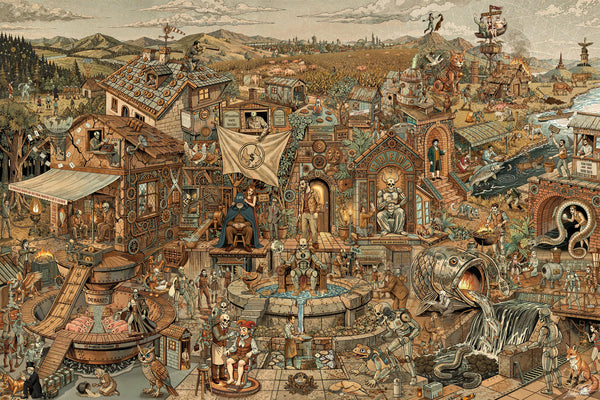
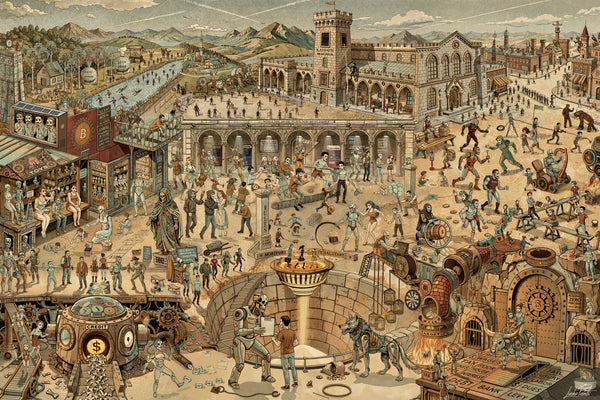
Fiat Fames is built on Pieter Bruegel the Elder's The Fight Between Carnival and Lent, painted in 1559. Every year the town feasted before Lent, with meat and beer and waffles and plays in the street, and then the fast began. Bruegel staged the changeover as a joust in a Flemish town square. Carnival is a fat butcher straddling a beer barrel on a sled, with a pie on his head and a roast on a spit for a lance. Lent is a thin woman on a cart pulled by a monk and a nun, and her lance is a bread paddle with two herrings on it. The whole town is out around them, from the inn on the left to the church on the right.

Mine keeps the square, the inn, the church and the joust. In Bruegel's town the feast and the fast take turns, and everybody knows the calendar. In mine the feast never ends for the people at the top and the fast is for everyone else. The calendar gets set by a committee.
There's a lot in this one. Here's the map.

- The fight
- The party
- Led by the fool
- The fast
- The fat kitchen
- The granary is full
- Lent
- The storehouse
- At arm's length
- Cold storage
The fight

In the middle of the square, Carnival rides his barrel again. Mine is a $ skull with long hair, a vest with $ badges and a pie for a hat, with EASY MONEY around the band. He's got a $ money bag in one fist and a spit in the other, loaded with a pig's head and a string of sausages. The end of his barrel reads PORK BARREL over a grinning boar and a $, and around the rim, AURI SACRA FAMES.
Edward Everett Hale used pork barrel for public spending in 1863, in The Children of the Public. By the early 1870s it meant what it still means: money for local projects, spent to win votes.

In Bruegel, Lent rides into the joust herself. In mine Lent stays back with the cart, and the one who takes Carnival on is a wizard in a Satoshi mask. He wears a cream robe with burnt orange trim and a tall pointed hat, and he carries a crooked staff with a glowing ₿ at the top. Behind him, a crowd in Satoshi masks has its hands in the air.

Carnival's spit is aimed at the wizard. The light from the staff is aimed back at Carnival, and a golden bolt runs from the wizard's open hand straight into the money bag. Of everything in that square, the coin on the end of his staff is the one thing Carnival can't print more of.
On the ground between them sit a bucket of herrings lettered FAST FOOD, which is Lent's food, and a bin lettered TRICKLE DOWN.
Auri sacra fames is the end of a sentence from the third book of the Aeneid. The start of it is down in the cellar.
The party

Bruegel's inn stands on the left with a blue boat on its signboard. It's the Blau Schuyt, the Blue Barge, and out in front of it the town is performing a play called The Dirty Bride.
Mine is THE PUNCH BOWL. There's a punch bowl on the hanging sign and a $ on the gable, people are drinking at the tables under the striped awning, and three plain faces lean out of the upstairs window. The one on the left has CUI BONO on a T-shirt, Latin for who benefits.
William McChesney Martin ran the Federal Reserve from 1951 to 1970. In a speech on October 19, 1955, he said the Fed was in the position of "the chaperone who has ordered the punch bowl removed just when the party was really warming up." That was supposed to be the job. In this town nobody's taking the bowl away.

Right under the party, the bank is closed. The sign over its barred gate reads BANK HOLIDAY, and a plate on the wall reads WITHDRAWALS SUSPENDED. A $ skull guard in copper armor stands at the door with a halberd, next to barrels lettered IOU and RESERVES. The reserves barrel has a coin slot that reads INSERT COINS.
Thirty-six hours after Franklin Roosevelt took office in 1933, at 1:00 a.m. on Monday, March 6, Proclamation 2039 suspended every banking transaction in the country. The holiday was set to run through March 9 and got extended. Savings banks could honor withdrawals of up to $10 for urgent needs. Banks started reopening on March 13.
Now look at who's at the gate. Three plain-faced depositors stand at the bars, wanting in. The crowd in Satoshi masks has turned its back on the shut bank, and it doesn't touch them. The only coins nobody can lock behind a gate are the ones you hold yourself, with your own keys.
Led by the fool

Behind Bruegel's joust, a couple walks away from us behind a fool in a striped costume, who carries a torch in broad daylight. The man has something stuffed on his back under his clothes. The woman carries a lantern, and it isn't lit. They're following the fool instead of reason.
In mine, the fool is a $ skull in a jester's suit printed all over with $ signs, and he holds his torch up high. The woman behind him wears a white headscarf. Her lantern has a ₿ in the window, and it's dark. The man beside her carries a sack on his back with a hole in the side, and a trail of gold coins runs out of it down the street behind them.
She's carrying the answer and hasn't lit it. They follow the fool's light instead, and their savings leak out of the sack the whole way.

Right beside them is the fish stall. The price tags on the fish have been crossed out and raised, $4 to $6 and $6 to $9, and under the table a bucket marked SAVINGS is leaking onto the stones.
Plutarch quotes Cato the Elder: "It is a hard matter to save a city in which a fish sells for more than an ox."
The fast

Up the street, past bunting that spells out FIAT FAMES and then CUI BONO?, is the ration office. A $ hangs over its door and a tall stack of coins stands against the wall. The sign in the window reads INFLATION 3%, NOT COUNTING FOOD OR FUEL, and a line of plain-faced women waits at the counter with their papers. The number they quote you leaves out food and fuel, and food and fuel are what you buy every week.
Pinned by the door is a calendar headed FOMC 2026. The Federal Open Market Committee sets the price of money for everybody who holds dollars. Its meetings are circled in red, except September, which gets a herring. On September 16 the committee raised its target range a quarter point, to 3-3/4 to 4%, twelve votes to none. On October 28 it held, ten to two. December is still blank.
Bruegel's town didn't need a committee to tell it when to fast. Shrove Tuesday was the feast and Ash Wednesday started the fast, and this year they fell on February 17 and 18. The fasts that matter now come out of Washington, on the committee's schedule.
Out front, hundreds of hooded Satoshi masks march the length of the street, and a sign along the way reads FIX THE MONEY. Look at what they're carrying. One crate reads SEED, DO NOT EAT. Another reads 21M BTC.
Plutarch tells how Cato tried to talk the Romans out of a handout of grain: "It is a hard matter, my fellow citizens, to argue with the belly, since it has no ears." The women at the counter are in line for the handout. The march is holding on to its seed.
In front of all of it, a $ skull walks off with a sack full of bread, right under the bunting that asks CUI BONO?

Down by the kitchens, a plate on the wall reads EDICTUM DE PRETIIS, over a machine labeled PRICE CONTROLS whose screen reads INCREASE, with a +10% button. Beside it are the grill's PRICE COOKER controls and a big valve wheel lettered LIQUIDITY.
In 301 AD, the emperor Diocletian issued the Edictum de Pretiis Rerum Venalium, the Edict on Maximum Prices. It put a ceiling on prices and wages across the empire. A seller who charged more could be put to death, and so could a buyer who paid more, and so could anybody who held goods back. All the while his mints kept turning out debased coins, so prices kept climbing anyway. Merchants stopped selling or went to barter, and the edict didn't last.
On August 15, 1971, Richard Nixon signed Executive Order 11615 and froze prices, rents, wages and salaries for 90 days. He called it the first peacetime wage-price freeze in American history. The same weekend, he closed the gold window.
Price controls are the decree that comes after the money decree, and a money nobody can print never needs it. First you print the money, then you make it a crime for prices to tell anybody.
The fat kitchen
Bruegel designed two kitchens too. In 1563, Pieter van der Heyden engraved The Fat Kitchen and The Thin Kitchen after Bruegel, and Hieronymus Cock published them. In the fat one, everybody's stuffed, and the verse under it tells a thin man at the door to go away, however hungry he looks. It's a fat kitchen, and he doesn't belong there.
Fiat Fames puts both kitchens in the cellar under the square. The fat one starts at the wizard's feet.

Carnival's grill runs on oil. A bottle with a $ on its label sits on a machine lettered PETRODOLLAR, with a 1974 plate and gauges that read USD DEMAND and SURPLUS, and a fuel line runs from it to a grill full of steaks and sausages. $ skull androids work the tongs. A plain woman in a long coat stands at the edge of the fire with a card in her hand.
On June 8, 1974, the United States and Saudi Arabia signed an agreement on military and economic cooperation, negotiated by Treasury Secretary Bill Simon and Henry Kissinger. Oil was already priced in dollars. The arrangement kept it that way, and Saudi oil money went into US Treasuries. There's no official memo of what was promised.
Every barrel sold in dollars means somebody, somewhere, needs dollars. That's how a country prints and still finds buyers for its money.

Down in the cellar on the left, two $ skulls in fur collars shove scrap into a smelter lettered DEBASEMENT: tin cans, gears, horseshoes, bolts, spoons. Coins stamped with a $ pour out of the bottom down a chute, and the gauge on the side reads INFLATION, with the needle in the red.
Around the mouth of the furnace runs the start of Virgil's sentence, QUID NON MORTALIA PECTORA COGIS. Put it together with the end on Carnival's barrel and the whole thing reads quid non mortalia pectora cogis, auri sacra fames! What do you not drive mortal hearts to, accursed hunger for gold.
Diocletian's mints at least had to find some metal for every coin. Fiat doesn't.

Under the smelter, a $ skull in a fur coat lies flat on the floor scooping coins off a pile by a sign that reads FIRST IN LINE. He's sprawled across sheets of ration coupons, and one of them is already torn out. Beside him, a ladder carries a can lettered DEBT on every rung, under a sign that reads ROLL OVER.
New money doesn't land on everybody at once. Whoever's first in line spends it at yesterday's prices, and everybody after him pays tomorrow's. Meanwhile the DEBT cans just keep climbing the ladder.

In the middle of the cellar, the big pot is lettered YOUR SAVINGS. Hams hang over it, pigs walk up a belt into it, and the fire under it is going strong. Next to it, a $ skull android stirs a smaller kettle that reads TOIL AND TROUBLE / DOUBLE, DOUBLE, the witches' chant from Macbeth.

At the far end of the fat kitchen, a $ skull butcher in an apron pushes a pink piggy bank into a meat grinder. The block under the grinder reads SAVINGS IN / SAUSAGE OUT, and the plate on its front reads 2% / GROUND. On the wall behind him, a poster reads SAVING IS HOARDING, SPEND IT NOW. The coins on the floor read LEGAL TENDER FOR ALL DEBTS and FULL FAITH AND CREDIT.
2% a year is the Fed's target, and it sounds like nothing. At 2%, a dollar saved at 30 buys half as much at 65. Nobody gets to set an inflation target for a money capped at 21 million.
The granary is full

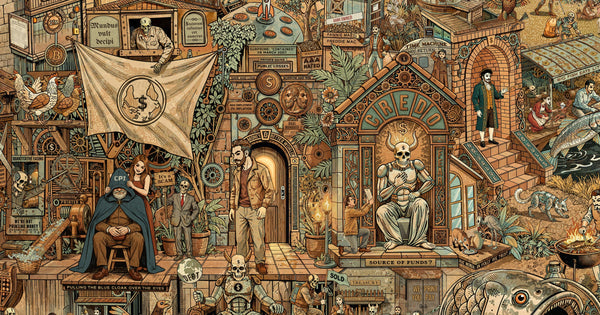
The right side of the cellar is the thin kitchen, and it's cold. There's frost on the stone, icicles hang off the vault and the rock ledges, and the food is locked behind bars in a cage with two plates on top, SHELF STABLE and STRATEGIC RESERVE. In the middle of it stands the vault from the top of this post. The hub of its wheel is a sheaf of wheat, and around it runs FIAT · FAMES.
Genesis has the original. When the famine came, aperuitque Joseph universa horrea: Joseph opened all the granaries, and sold the grain. He took all the money in Egypt and Canaan for it. When the money was gone, the Egyptians came back to him for bread, "for the money faileth." He took their livestock for bread. Then he took their land, and then the people themselves went into servitude.
Who eats depends on who holds the grain and what they'll take for it.

Lined up against the vault are three tins, 401(K), SOCIAL SECURITY and PENSION. The 401(k) came out of the Revenue Act of 1978 and took effect on January 1, 1980. In June 2026, the Social Security trustees put the date the retirement trust fund runs dry in late 2032, with 78% of benefits payable after that. The combined funds last until 2034, with 83% payable. Every one of those tins is a promise paid in dollars, decades out, in whatever those dollars buy by then.
A few feet away, a horned $ skull android has a striped straw stuck in a tin marked MILKSHAKE, 16 OZ, lined up with WAGES, COLLEGE FUND and a RAINY DAY tin half hidden behind the lion. "I drink your milkshake" is the line from There Will Be Blood (2007). Paul Thomas Anderson said he took it from transcripts of the 1924 Teapot Dome hearings, where Albert Fall used a milkshake and a straw to explain oil drainage. Inflation drinks the same way. Nobody has to open your tin, because the straw's already in it.
Behind them, two cans read NOW 12 OZ and WAS 16 OZ. Shrinkflation is the price rise that never shows up on the tag.
Lent

Back up on the square, Lent stands with the cart on the right. Bruegel's Lent is thin and pale, with a beehive on her head, and her cart carries pretzels and bread. Mine wears a gray hooded robe and the classic Satoshi mask, and still holds up the bread paddle with two herrings on it. Bruegel's beehive went over the door of the storehouse. Lent has left the jousting to the wizard and stayed with the bread.

Lent's cart is lettered PRICES SUBJECT TO PRINTING. It's loaded with wheat sheaves, pretzels and three loaves of bread, each stamped with a price and a year: 5.6¢ 1913, 50¢ 1980 and $1.83 2026.
Those are Bureau of Labor Statistics prices for a pound of white bread. It was 5.6¢ in January 1913, the year Woodrow Wilson signed the Federal Reserve Act. The 1980 average was 50.9¢. In September 2026 it was $1.83. Same bread at more than 32 times the price, and the baker didn't get 32 times better at baking.

Across the square, in front of HARD MONEY HALL, a stall under a striped canopy reads PAY IN SATS. The canopy reads BAKER'S DOZEN, the chalkboard beside it reads BREAD with 10,900 crossed out and 2,250 underneath, and the front of the stall reads 2,250 SATS, so in sats the bread got cheaper.
The fountain in front of the hall has a fish on top of its column, Lent's fish, and two of the masked crowd around it have lines in the water, while the rest hold up what they've caught.
The storehouse

Bruegel's church stands on the right with its door open, and out front a man sits at a table with a relic that the pious can pay to touch.
Mine is a storehouse. The rose window is a hoist wheel, a beam at the top of the gable lifts a sack with a ₿ on it, and Lent's beehive hangs over the door with a ₿ on it too. The plaques on either side of the door read SERVATUM, kept, and NON FIAT, let it not be done, each one topped with a ₿. The pennants on the towers read SAVE, HOLD and WAIT.

The door's open, and you can see what's inside: herrings hanging from the rafters, clay crocks on the shelves, casks and sacks.
Bruegel's Lent was a season everybody had to sit through. Here the fast is a choice. You spend less than you earn and put the rest somewhere nobody can print more of. Then you wait.
Bitcoin's supply is capped at 21 million. Every 210,000 blocks, the new coins paid out for each block get cut in half. The last cut came on April 20, 2024, at block 840,000, from 6.25 to 3.125 bitcoin. The next one is due at block 1,050,000, in 2028. There's no committee that meets to change it.

Out front, where Bruegel's relic table stood, there's a table lettered SEED BANK with a tray of seeds and a small scale. At the next table, a masked man stacks his own ₿ coins. Seed is the one thing a hungry town can't afford to eat, which is what that crate in the march was saying too.
In front of the seed bank, a masked woman kneels and holds out a full bowl of grain to a ragged kid with an empty one. Bruegel's beggars wait outside the church. This kid gets fed by somebody who saved.
At arm's length

Most of this piece is built to be read close.
Up on the rooftops, a drone with a camera hangs over the hills near a bonfire burning in a ring of standing stones. A second drone drops bills over the street. A golden calf stands on one chimney, and a stone eagle with a $ shield on its chest stands on another. On the chimney of the ration office, a weathervane lady in green holds a ₿ coin up to the sky. A weathervane's whole job is to show which way the wind is turning.
Some of the lettering reads from across the room: THE PUNCH BOWL, BANK HOLIDAY, YOUR SAVINGS, GRANARY. The rest waits until you're standing at arm's length, like CUI BONO on a T-shirt in the inn's upstairs window, the 1974 plate on the petrodollar machine, the herring on September on the FOMC calendar, NOW 12 OZ on a can in the cellar, and the ₿ in the window of a lantern nobody's lit.
Cold storage

At the bottom right of the piece, in the cold kitchen, a lion in a Satoshi mask keeps one paw on his COLD STORAGE can, with a ₿ on it. The lion's share, kept offline, where nobody else holds the keys. Every other tin in that cellar can be shrunk or drunk by somebody else. The only paw on that one is the lion's.
A few steps away, a mother in a headscarf and her boy hold on to a broken chain. Its snapped end lies on the floor by a few orange ₿ coins. A can marked RATION sits on the floor behind them, and another one lies on its side in front of the lion.
The mother and her boy were holding on to a false security, and it broke. The lion guards his own.
The granary is full, and the hunger is in the money.
Better money, better world.

The print. 30 x 20 inches on Hahnemühle German Etching 310gsm. Signed and numbered, edition of 10, $600. Certificate of authenticity timestamped on Bitcoin. The edition opens Saturday.
Fiat Fames is the sixth of the Ten Decrees. The fifth, Fiat Moria, is the village that wants to be deceived. The fourth, Fiat Ludus, is the game the house rigged. The third, Fiat Palea, sorts the harvest. The second, Fiat Lucrum, is the party the money came from. The first, Furia Fiat, is the one with VERIFY cut over the gate.
Bitcoin Magazine interviewed me about Ten Decrees in October 2026. Read about the interview and the Bitcoin Amsterdam main stage.
Leave a comment