

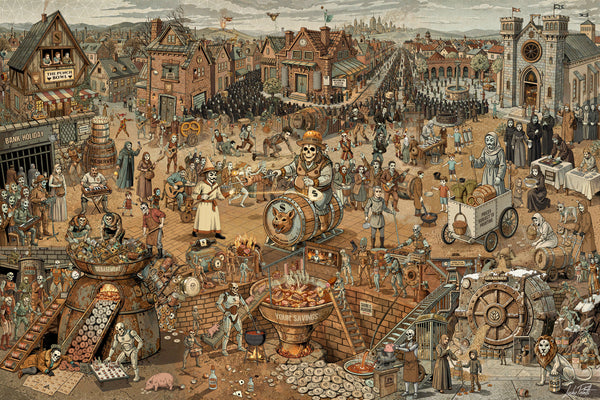
On December 1st, 2001, Argentina locked its savers' money inside the banks. In the middle of Fiat Refugium, two beams sandbagged with $ sacks read YOUR MONEY GOES NOWHERE and WITHOUT PERMISSION. Under them, plain-faced people in everyday clothes are penned behind steel barriers along with the system's enforcers, and two $ skull guards stand at a shut door with a ₿ on it.
Up above this scene, a niche under the word REFUGIUM is lit from the inside by a glowing orange ₿.
Fiat is Latin for let it be done. A decree, issued once, with nobody asked. Refugium is a refuge, the place you run to when home stops being safe.
Fiat Refugium. Let there be a refuge.
When a money fails, the last thing the state does is lock your savings inside it. Argentina did it in 2001 and Cyprus did it in 2013. The only refuge left is a money nobody can lock up.
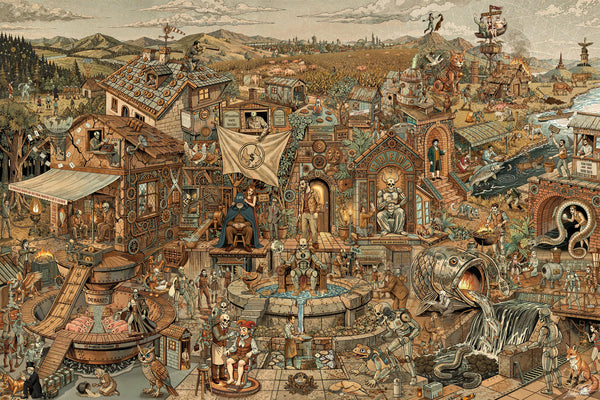
Fiat Refugium is built on Hieronymus Bosch's The Temptation of St Anthony, the triptych in Lisbon, painted around 1501. Anthony was the hermit of the Egyptian desert. In the Life of Antony that Athanasius wrote around 360, he walls himself into an abandoned fort for close to twenty years, his bread is let down to him over the wall twice a year, and the demons fill the place with noise, crying "Go from what is ours." Bosch gave the demons a whole town. They carry Anthony through the sky, a village burns behind them, ships sail through the air, and a crowd of them holds a church service of its own around him. In the middle of all of it he kneels and turns his hand back toward a dark cell in a ruined tower, where a Christ figure stands at an altar.

Mine keeps the cell, the column, the crowd, the burning town and the ships in the sky, and moves the core of the story to Argentina, from November 2001 to February 2002. Signs and inscriptions throughout the piece carry dates from that stretch, from 30 NOV 2001 to 3 FEB 2002, and this post follows them in order.
There's a lot in this one. Here's the map.

- The refuge
- Not by decree
- The corral
- They should all leave
- He who deposits dollars
- One dollar, 1.40 pesos
- Assets under management
- The table
- The newest corral
- Break glass
The refuge

Bosch put the most important thing in his picture in one of its darkest spots. Through a doorway in the ruined tower, a Christ figure stands in a chapel beside an altar with a crucifix and a candle. Anthony kneels out front and turns his hand back toward him. The crowd around them is busy with a service of its own, and nobody else looks in.
In mine the cell is the refuge, and it's lit. REFUGIUM is set in a plate over the arch, and a glowing orange ₿ sits in the niche below it. A Femme Satoshi in a crown of rays stands at the altar table with her hand held out over a cup, next to a little box lettered P2P. At the other end of the table, a robed Satoshi holds a glass of wine in his right hand and an IOU in his left, over a scale. One pan of the scale holds a single ₿ coin, the other holds a heap of IOUs, and the heap is the one up in the air.
To the left of the arch, a counter reads 975146 over TICK TOCK and NEXT BLOCK. That's a real block number, mined on November 9th, 2026. Bitcoin adds a new block about every ten minutes.

Out front, where Bosch's Anthony kneels, a hermit in a brown robe and a Satoshi mask sits on the steps with his right palm raised and a book in his left hand. On the front of the altar platform, off to his left, hangs a notice for EXECUTIVE ORDER 6102. We'll get to it at the end.
Not by decree

Right next to Bosch's cell stands a column carved with scenes from the Old Testament, the golden calf among them, the idol the Israelites made out of their own gold while Moses was up the mountain. Fiat Refugium keeps the column and changes what's carved on it.
Its drum reads 1 BTC = 1 BTC. Down the stones it reads NOT BY DECREE, then 21,000,000, then a question and its answer: WHAT BACKS IT? PROOF OF WORK, NOT PROOF OF NOTHING.
Argentina already had a one-to-one. Convertibility law 23.928 pegged Argentina's peso to the dollar from 1991 through 2001. It held for ten years and nine months, and it ended the way it started, with another law. A peg that a law can set, the next law can take away. Nobody can vote on the 21 million, and every new bitcoin has to be paid for in work and electricity before it exists.

Right beside the column, the masked crowd stands shoulder to shoulder, in the spot where Bosch's crowd never looks. Near the front, an older hooded woman holds a small screen reading ₿ 0.1 and puts a ₿ coin into a girl's hand. It's the one kind of savings in this piece that can't be frozen, handed to the next generation. At their feet sits a wooden crate lettered SEED.
The corral

The run started before the lock. In the last three days of November 2001, about 3.6 billion dollars left Argentina's banks. On the road at the left of the piece, a wagon of $ sacks marked 30 NOV 2001 rolls along beside a $ skull robot riding a rhea, a large bird native to South America.
Right next to it, two plain-faced men in tweed carry a riveted car lettered BANK. The older one walks bent under the front of it with his hand over his face. A $ skull in a suit lounges on the roof and points the way. The public carries the bank, and the system rides on top.
On December 1st, 2001, President Fernando de la Rúa signed Decree 1570, drawn up by his economy minister, Domingo Cavallo, the same man who had built the one-to-one dollar peg as economy minister in 1991. From December 3rd, nobody could withdraw over 250 pesos or dollars a week from a bank in cash. People named it the corralito, the little corral, the word Argentines use for a baby's playpen. Back at the roadside, a sign shows a $ skull over the word TEMPORARY. Cavallo announced it for 90 days. It ran a full year, until December 2nd, 2002.

In the middle of the piece, the corral is literal. Two beams sandbagged with $ sacks and razor wire read YOUR MONEY GOES NOWHERE on the left and WITHOUT PERMISSION on the right. Under them, plain-faced people in everyday clothes stand penned behind steel crowd barriers, packed in with $ skull androids, and a $ skull guard in uniform stands at the end of the rail.
At the front of the pen, a 24 HR CASH machine reads OUT OF SERVICE and NO CASH, with a sign on its side, LIMIT $250 A WEEK. Next to it, a bin lettered GOVERNMENT PROMISES is stuffed with torn paper, and an old woman sits caged in a wooden crate holding her red PENSION book.

On the left side of the altar platform, a switch box lettered WITHDRAWALS has two settings, OFF and ON, and its lever is padlocked at OFF.
They should all leave

Eighteen days after the decree, the country broke. On the night of December 19th, De la Rúa went on television to declare a state of siege. Within minutes of the speech, people across Buenos Aires came out onto their balconies and into the streets banging pots and pans, and marched on the Plaza de Mayo. It's called a cacerolazo, from cacerola, a saucepan.
In the frame, a big gold coin stands split down the middle, the $ on one half and the 1 on the other, the one-to-one broken in two. Beside it, a plain-faced woman in a brown cardigan holds a pan up over her head and shouts at a riot cop with a skull for a face, behind a $ shield.
Right beside the riot cop stands the answer, a wheel on a post with 21M at the top and BTC at the bottom. Around it run the bitcoin paid out for every block, halving on schedule about every four years: 50.0 in 2009, then 25.0, 12.5, 6.25, 3.125, and 1.5625 in 2028.

By the next day the plaza was chanting ¡Que se vayan todos! (they should all leave). On the evening of December 20th, De la Rúa resigned and left the Casa Rosada, the presidential palace, by helicopter from the roof. Over the next twelve days, four more men held the presidency.
Here the chant is carved over the mouth of a cave, THEY SHOULD ALL LEAVE, and a bell hangs inside. Next to the bell, a Femme Satoshi in a pale hooded robe stands with one hand on her chest and a ₿ coin in the other. She kept her coin while the banks emptied. In front of her sits a strapped trunk with a ₿ lock plate and an EXIT tag hanging from the handle, and to the right a birdcage hangs open and empty. Whoever packed that trunk left with their keys, and the bird has already flown.

On December 23rd, one of those presidents, Adolfo Rodríguez Saá, stood before Congress and announced that Argentina would suspend payment on its foreign debt, more than 100 billion dollars of it. Bosch set a village burning at night behind his crowd. This town burns too, under smoking mountains, with a $ sign hanging over a burning arcade, and over on the right of the piece, a vulture spreads its wings over a sign reading DEFAULT, 23 XII 2001.
He who deposits dollars

On New Year's Day, 2002, Congress named Eduardo Duhalde president. In his first speech to the Legislative Assembly as president, he promised, "El que depositó dólares recibirá dólares": he who deposited dollars will receive dollars.
Here the promise is lettered on a banner around a striped tent, with smoke pouring out of the top of it. Under the banner, a $ skull stands at a lectern marked VOW, with a megaphone, and plain-faced believers on both sides of him hold red passbooks up over their heads.
On January 6th, Congress passed Law 25.561, and the one-to-one was over.

Down at the bottom left of the piece, the old law lies on the ground in pieces. LAW 23.928, CONVERTIBILITY and 1 PESO = 1 DOLLAR are carved big down the slab, with the fine print of the law above and below. A giant $ skull robot with DECREE 1570/01 on its chest rises out of a burning pit with a rubber stamp in its hand, and the edge of the slab reads REPEALED 6 JAN 2002.
A plain-faced man lies on his back across the pieces, next to two yardsticks, 1 DOLLAR in one piece and 1 PESO snapped in two. A Femme Satoshi runs across the slab past him, holding up her skirt with one hand and clutching a small ₿ pouch to her chest with the other.

After the demons beat him, Bosch's Anthony is carried home across a bridge by his friends. Nobody comes for this one. He lies where he fell, and the woman with the pouch keeps running.
One dollar, 1.40 pesos

On February 3rd, Decree 214 settled it. Every dollar in the bank became 1.40 pesos, and every dollar owed to a bank became one peso.
The DEPOSITS booth posts the rate, 1 DOLLAR = 1.40 PESOS, DECREE 214 · 3 FEB 2002, and a $ skull clerk sits behind the window, walled in by $ sacks. A line of plain-faced savers waits at it with their own sacks: LIFE SAVINGS, RETIREMENT FUND, KID'S COLLEGE FUND, INHERITANCE, EMERGENCY FUND and DOWN PAYMENT.

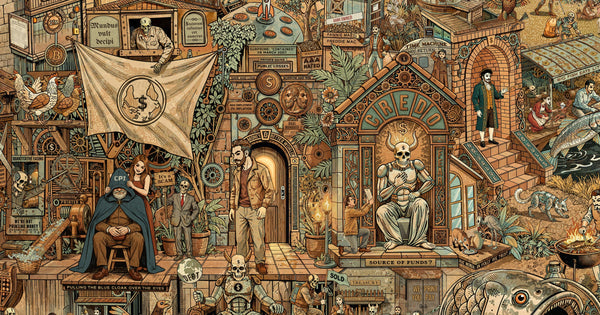
The window's rate was set by decree, and the street paid no attention to it. Up on the hill at the left of the piece, a gauge lettered INTERNATIONAL MONETARY FUND reads PESOS PER DOLLAR, with its needle in the red between 3 and 4, next to a tower marked DEBTOR WATCH. By late June 2002, a dollar cost 3.90 pesos on the street. At that rate, the 1.40 pesos a saver got for her dollar bought back about a third of it.
Right below the gauge, a little doorway is lettered OPT OUT, and there's a ₿ inside it.
Assets under management

The sacks don't stay at the window. A bronze chute with windows in it carries them from the booth into a machine lettered ASSETS UNDER MANAGEMENT, with BACKED BY THE FULL FAITH AND CREDIT OF THE STATE around its collar. Under that, a small plate reads YOU DEPOSIT, WE BURN, over a furnace full of burning $ sacks, and the screens of the CAPITAL CONTROL CENTER read OUTFLOWS BLOCKED and WITHDRAWAL LIMIT $250 PER WEEK.
On the rim of the hopper, a $ skull in a brown suit cranks the winch on a hanging cage marked IN CUSTODY. The woman inside is there because she let her savings be held in custody.
This wasn't only Argentina. In March 2013, Cyprus shut its banks for almost two weeks. When the bill came, 47.5% of every euro above €100,000 at the Bank of Cyprus was turned into the bank's own shares, uninsured savers at Laiki Bank got back about 6 cents on the euro, and the capital controls stayed in place for two years, until April 2015. The word for it was a bail-in, the bank saved with its depositors' money.

To the right of the hopper, a couple sits in a dark arch under a notice reading FORECLOSED, BY ORDER OF THE BANK, with a roped suitcase and a fire in a tin drum at their feet. Below them, the ledge of the pit reads ALL FIAT MONEY IS BORN AS DEBT, and a press rolls out sheets marked DEBT to a $ skull in a booth marked MONEY CHANGER.
The table

Somebody had to pay for the gap between 1.40 and 1. The banks owed their depositors 1.40 pesos for every dollar and collected one peso for every dollar they'd lent, and the state covered the hole with a recapitalization worth about 9 billion dollars.
In Bosch's right wing, a table set with bread and a jug is held up on the backs of naked men, one bent double and one hanging upside down beneath it. This one is set with gold bars, a knife and fork, a pitcher lettered LIQUIDITY and a jar of YOUR LIFE SAVINGS. A $ skull banker sits at it with a drink, and a little card on the tablecloth reads DEBTS 1 = 1.

Behind him, a wall of safe deposit boxes sits under the word DEPOSITUM. The top row is still locked, and most of the boxes below it hang open and empty. In Roman law a depositum is something you hand over for safekeeping, to be given back when you ask for it. The screens next to the boxes read REQUESTS and a list of accounts, each one DENIED, then a padlock over FROZEN, and ACCESS 0%, PERMISSION REQUIRED, over a PERMISSION DESK where a horned $ skull clerk holds up his hand.
The newest corral

A corral used to need a decree and a guard at the door. In October 2020, the city of Shenzhen ran a lottery and gave 200 digital yuan each to 50,000 winners. The money could only be spent at listed shops in one district, couldn't be transferred to anyone else or put in a bank, and expired after a week, with the rules written into the money itself.
In the bottom right corner, a machine lettered CENTRAL BANK carries a plate reading PROGRAMMABLE, CENSORABLE, FREEZABLE MONEY, over DIGITAL CURRENCY. A row of blocks spelling C B D C runs out of it on a chain. A plain-faced man crawls on all fours toward a bone lettered STIMULUS, chained by the collar to the first block, past a cyborg lizard crouched under the chain. A Femme Satoshi swings an axe at the chain, and a horned robot with a camera lens for an eye grabs the handle.

Bosch put a crippled man at the foot of Anthony's altar, hauling himself up the step with a gold cup in his hand. Mine crawls toward a handout, and the leash is the money.
Break glass

On the front of the altar platform, the notice for EXECUTIVE ORDER 6102 reads ALL GOLD MUST BE DELIVERED, COIN, BULLION AND CERTIFICATES, TO A FEDERAL RESERVE BANK BY MAY 1, 1933, and at the bottom, $10,000 FINE OR 10 YEARS IMPRISONMENT. That was Franklin Roosevelt's order, and those were its penalties. Next to the notice, on the opposite side of the altar platform from the WITHDRAWALS switch, a box on the wall reads IN CASE OF CRISIS, BREAK GLASS, with a ₿ key behind the glass.
Gold has to sit somewhere, in a vault or under a floorboard. Bitcoin is held with a key, and the key can be twelve words you know by heart.
A few steps away, Doctor Satoshi sits at his pill press, pushing orange pills down into it, next to a prescription bottle marked ℞, a tray lettered ORANGE PILL and BITCOIN, and a Bitcoin miner with a kettle heating on top.

Up on the hill at the left, a road winds past signposts with their names crossed out in red: MARK 1923, PENGŐ 1946, Z$ 2008, BOLÍVAR 2018. Each one is a money its own government printed into the ground, Germany's mark in 1923, Hungary's pengő in 1946, the worst hyperinflation ever recorded, Zimbabwe's dollar in 2008 and Venezuela's bolívar in 2018. Travelers in Satoshi masks with packs and lanterns walk the road, leaving every one of them behind, and past BOLÍVAR the last sign carries a ₿.

Over on the right, under an orange canopy, a hologram of a woman glows inside a hollow tree, where Bosch put a naked woman in a tree trunk as one more temptation. In front of it, a plain-faced boy holds a gold key in both hands. Next to him, a hooded Satoshi carries a box lettered HODL LONG BTC, and the plate on its lid carries twelve words cut to their first four letters, WOLF, TRUS, PROO, WORK and the rest, the way people stamp a seed phrase into steel.

In Bosch's right wing, Anthony sits apart with his book and looks back at us over his shoulder. The reader here sits in a chair by the river in a gray robe with a ₿ on the chest, reading a book headed NULLIUS IN VERBA, the Royal Society's motto, take nobody's word for it. Under the title run lines of numbers, 975139 to 975142. Those are blocks too. Bitcoiners say don't trust, verify, and he's doing the verifying himself, block by block.

And over all of it, where Bosch's demons sail, a man in a Satoshi mask and a woman ride a flying mechanical fish lettered BTC 21M, and airships lettered BTC, BITCOIN and SOUND MONEY fill the sky, the BTC and SOUND MONEY ships towed on long reins by griffins.

Back in the middle of the corral, the door between the beams has a ₿ on it, BETTER and MONEY on the pillars either side, and THIS MONEY GOES ANYWHERE across the top. Two $ skull guards in uniform stand in front of it.
The Argentines who kept their dollars in a drawer at home in December 2001 still had every one of them in February. The ones who trusted the bank got 1.40 pesos for each, and by June a dollar cost 3.90.
Your money goes nowhere without their permission. This money goes anywhere without it. They can guard the door, but they can't open it.
Better money, better world.
The print. 30 x 20 inches on Hahnemühle German Etching 310gsm. Signed and numbered, edition of 10. Certificate of authenticity timestamped on Bitcoin. Fiat Refugium print.
Fiat Refugium is the seventh of the Ten Decrees. The sixth, Fiat Fames, is the town with a full granary and the hunger in the money. The fifth, Fiat Moria, is the village that wants to be deceived. The fourth, Fiat Ludus, is the game the house rigged. The third, Fiat Palea, sorts the harvest. The second, Fiat Lucrum, is the party the money came from. The first, Furia Fiat, is the one with VERIFY cut over the gate.
Bitcoin Magazine interviewed me about Ten Decrees in October 2026. Read about the interview and the Bitcoin Amsterdam main stage.
Leave a comment